Drop Down MenusCSS Drop Down MenuPure CSS Dropdown Menu

Wednesday, June 15, 2011

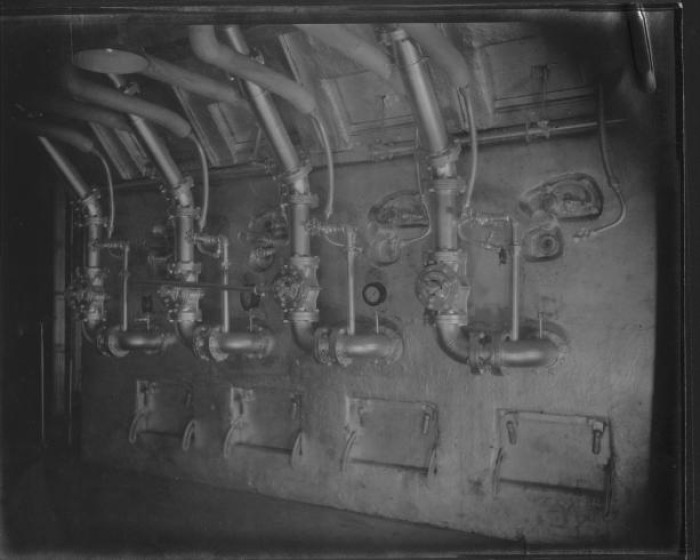
Power Plant in The Imperial Sugar Refinery


I was searching the Web site, The Portal to Texas History, for an old photo of Imperial Boulevard. I came across these pictures of the Power Plant in the Imperial Sugar Refinery. I worked there as a summer hire in the late '60s & early '70s while I was in college. I recognized these locations right away.

In fact, I went through the Power Plant several months ago as Johnson Development demolished much of the refinery complex. It's funny how much still looked like it does in these pictures. If you've driven down Highway 90A recently, you'll notice that nothing now remains of the Power Plant except two smoke stacks for the old boilers.

These undated photos come from the Fort Bend County Museum Collection. I've included a link to the site so you can see other photos they've posted.


Link to The Portal to Texas History Web Site

Tuesday, June 14, 2011

Humble Camp Update


My aunt, Mayme Rachuig Hause, sent me a couple more items about the Humble Camp. The first is a layout of the camp as she remembers it. The second is her short memoir of growing up out there. I enjoyed reading it.

You'll see that I was incorrect last week, when I said there were no stores out at the Camp. My aunt mentions the Erlichs, who ran the small store until 1940. Wayburn Hall (SLHS '43) told me his family moved out to the camp & ran it from 1940 to '42. Sugarland Industries operated the store rather than Humble Oil Company. Here's what Mr. Hall said:
"Chuck, my Family lived at the Humble Camp from about 1940 to 1942 in a house owned by Sugarland Industries. It was the first house on the left upon entering the Humble Camp. One of the pictures in your blog has a small building with a front porch in the front. I believe this was next to the house we lived in. Sugar Land Industries did operate some kind of a store there. The store had long been closed before we moved there. I knew all the people in the Humble Camp in the early 1940s."
I know the Industries allowed some Humble people to occupy houses in Sugar Land. My grandparents lived for a few months in the last small, brick house on Brooks Street when they first moved to Sugar Land in 1932. As soon as their house at the Camp was built, they moved out there.

Notice that Gulf Oil Company had an office at the camp. The field required co-operation between various companies, so Humble wasn't the only company working that field.

Link to diagram of Humble Camp

Link to memoir of life in the Humble Camp

Friday, June 10, 2011

Sugar Land's Humble Camp


The Humble Camp was a small community run by the Humble Oil Company. It had production & pipeline units. I always thought the production unit was very small because there weren't many wells on the Sugar Land side of the Brazos River, but based on photos I've found, I could be wrong.

The pipeline connected with sizable fields on Thompson's side of the Brazos & transported the collected oil northeastward toward the Baytown refinery complex.

Virtually all large, vertically-integrated oil companies in Texas had camps dotting their pipelines & oil fields. They were small company towns in many cases. The Sugar Land camp didn't have commercial enterprises (I believe I'm right about that), so it wasn't exactly a company town like Sugar Land, but it was a tight-knit community sustained & managed by Humble Oil Company.

My maternal grandfather, H. A. Rachuig, was head of the pipeline section of the camp, so my mother & her sister grew up out there. I've had a little difficulty in pinpointing its exact location in what is now First Colony. Oil Field Road ran from Highway 6 to the Camp in the old days. Now it's just a short street in First Colony. My best guess is that the camp sat somewhere near Manor Road. My brother has found the exact spot & taken pictures of it, which I've included in the photo album below.

(Update) My aunt, Mayme Rachuig Hause, took the modern pictures that appear in the online album. Bruce sent me this map which shows the location of the Camp in present-day First Colony.


Some of the pictures are low-resolution & a little blurry, but they'll give you an idea of life out at the Humble Camp. You'll see family snapshots of the Camp, plus photos I've found of the Sugar Land Oil Field taken in the late 1920s.

Unfortunately, the Web site where I found these photos is no longer in operation, so I can't give a lot of detail about what they show. I recall reading that Sugarland Industries leased its River bottom land for exploration, but little came of it. Maybe I can find out more with further research.
Link
(Update) My brother Bruce found this reference in The Handbook of Texas. It offers some interesting history on the Sugar Land Oil Field. After reading it I'm uncertain if the photos show Cockburn's exploratory drilling in 1927 or Humble's producing field. It's possible/probable they show both. The photo of the River bank could be an early photo of Cockburn's exploration. He doesn't appear in my notes, but a man named Nelson does. He either worked for Cockburn during exploratory drilling or Humble as they put the field in production. (I hope I can find the Web site where I found these photos.)

Link to entry in The Handbook of Texas

The album ends with a few pictures Bruce took of the remnants of the Camp in present-day First Colony.

Link to photo album of Humble Camp

Monday, June 6, 2011

Another How-Times-Have-Changed Story


Everyone says times have changed & takes it for granted. Concrete examples really make the point stand out. One of my favorites is the story about boys taking their shotguns to school so they could go duck hunting in what is now Venetian Estates before & after the school day. Here's a similar story I heard last weekend at a confab of old timers.

I don't know what year this incident happened, so I don't know what grade they were in, but it's part of the Class of 1951's lore. The scene was Miss Ford 'Add-Another-Ruffle' Berry's history class. (The origin of her nickname is another funny story.) Allan Landin had taken a board out of the bottom of his desk, pulled out his large pocket knife, & began whittling. Apparently, he was sitting on the front row, so Miss Berry was either so focused on the lesson that she didn't see the knife, or she figured whittling was ok as long as it kept Allan quiet.

Well, Allan placed the board vertically on his left thigh & began whittling downward toward his leg. The knife slipped & he slashed the inside of his thigh pretty good. Ron Miller said blood went everywhere. Allan said he cut some cord off the classroom blinds & made a tourniquet for his leg. Several boys helped him out of the classroom and set him on a bicycle which they used as a make-shift gurney to get him across the street to the hospital.

Well, Miss Nema was as alert as ever. She saw them coming across the street toward the front door. She yelled, "DON'T BRING HIM IN THROUGH THIS DOOR! HE'S BLEEDING!" I guess neatness & decorum trumped emergency procedures.

The boys ignored her & took him in the front door. I guess it all turned out ok because I saw Allan last Saturday & he lived to tell the tale. In fact, he said he still has the knife.

(Update) I just talked on the phone with B. I. Webb (SLHS '51) & got his version of the story, which is generally the same. He thinks it happened in the '48/'49 school year when they were sophomores. He also thinks Allan was whittling on a slat from an apple box. The knife was a single-blade, 4" knife. As Allan tried to split the slat using both hands on the knife & the slat balanced vertically on his thigh, the knife slashed through the dry wood and cut into his thigh. They used B. I.'s bicycle to get him to the hospital. Good stuff.

(Update) I got this note from Jackie James (SLHS '57); I thought it was funny. 'I really enjoyed looking at the pictures in Humble Camp. Had some really good friends that lived out there.......Barbara Burns, H.G. Bossley and Ray Barton all lived out there if I remember right. I have a couple of funny ones on "Miss Good morning merry sunshine" Barry. (That's how she greeted me in the hall when I visited SLHS the year after graduation). When we were in high school (class of '57) her room's windows looked out across Cleveland Lake to what was then called the Pecan Grove I believe. There were also cows grazing there at the time. If I remember right, we were in 8th grade. One of the guys kept a round cow head that when turned over mooed several times under his seat where we had places for our books. Every once in a while he would reach in and turn that cow over and it would moo and moo. Miss Barry would stop the class, look over at the cows in the Pecan Grove and say, "Those cows are really noisy today" and keep right on going with her lecture. A couple of other times someone put an alarm clock on top of the cabinet in the corner of the room by the blackboard behind her desk. It was set to go off about fifteen minutes before the bell was to ring. When that happened she would say, "My, my, that time really went fast today, get your books and see you tomorrow"!! Whoever did it didn't get away with that more than one or twice if I remember right because we didn't know what to do once we got out into the hall! I'll have you know "yours truly" had nothing to do with either of those happenings!!!! I was talking to Ronald Miller one time after he was in college and I was in 9th or 10th grade. The subject came up about Miss Barry and I was telling him those stories probably. Ronald said, "Jackie, I am going to give you some great advice! Listen to everything that lady has to teach you as she really knows her history and is much smarter than most kids think"!! I took his advice and when I was taking History in college at TCU my history professor wanted me to be his "assistant" and grade his papers for him because I was so good in history. TRUE STORY. Ronald probably doesn't remember but I do.'

Imperial Boulevard


A few month's ago I posted a copy of the old Sugar Land newspaper, Texas Industrial News, printed on December 6, 1924. It had a short article about Imperial Boulevard, which had just been named by residents living on that street. I know first-hand that many residents referred to Imperial Blvd. as 'Rat Row.' I can't recall who told me this, but the cotton gin & dairy (which sat at the east end of the street where it intersected Ulrich St.) attracted lots of rodents. Alec Horn has told me his father & uncle were paid to hunt (shoot) rats at night. (Alec's grandfather ran the feed mill.)

(Update) Gerald Culler reminded me that Imperial Boulevard went by another nickname, too: "Tin Can Alley."

(Update) I received this note from Ron Miller, whose family lived on Imperial Boulevard. "
I have another angle on why it was called Rat Row.
The railroad marshalling yard was to the north of our street and before Oyster Creek. The waste raw sugar from the plant was piled adjacent to the rr tracks, and the rats feasted on this substance and became quite large. And there were a lot of them. They tunnelled all over the place and for some reason elected to build exits in the back yards of the people that lived on the north side of the road.

My dad's brother, Johnny Miller, his wife, Selma, and son my cousin, Vernon, lived next door to us. Vernon was about four years older than me, and knew how to use a 22 rifle. He liked to do some rat plinking from time to time, and would set up in the back yard to do this. If it was a slow day for rat plinking, a water hose could be placed in one of the holes/exits for the rats and the caverns below filled with water. Of course, the rats escaped to the surface to the rifle fire of Vernon. Ron"


I wish I had a good picture of the street. The best I can do are the two below. They may have been taken at the same time, sometime between 1949 & 1951. (The Palms Theater appears in the pictures, & it was completed in 1949. The Shopping Center isn't under construction, & it began in April, 1949.)

Imperial Boulevard is the street running down to the lower- right corner of the first picture. You can just see the beginning of the houses. It's in the lower-left of the second picture.

(Notice Belknap. Just a few houses there.)


The earliest houses dated from 1922. A house was moved to the end of the street (north side) in 1946. Most houses were built in 1924 & 1925. My grandparents (Kellys) lived at 506. I always thought the street address was 811 because that's what's on my father's birth certificate, but actual street addresses weren't assigned until sometime in the 1930s when HL&P began supplying power to the town. Earlier street numbers (like 811) were a company reference, apparently.

Imperial Boulevard vanished with the expansion of Nalco in the 1970s.

Sports Ephemera


I found a Web site recently with 'ephemeral' from Houston's history. These were common-place things that are rarely saved, like cocktail napkins, business cards, advertising fliers, movie tickets, etc.

Rick Kirkpatrick had a couple of interesting (to me) items in his family archive. The first was an unused ticket to the first regular season game in the Astrodome. The 'Stros played Philadelphia & lost 2-0. Chris Short beat Bob Bruce.


The second item is a ticket to the Ali - Williams fight in the Astrodome in 1966. My father went to the fight, too. I remember him saying the most impressive thing that night was the 'Ali Shuffle.' He said Ali's feet were so fast, they were a blur -- like a ballet dancer's.

Here's a 10-minute video of the whole fight
.


Tuesday, May 31, 2011

Dorothy Schultz Gandy


Many of you have heard that Dorothy Schultz Gandy died recently. She was a long-time Sugar Land resident & a member of Sugar Land High School's Class of 1940.

I had some video of her from 2002. As you'll see, several women who'd lived in Sugar Land for many years got together to talk about old times. Mrs. Gandy was one of them.

The video & audio is a little rough, but I hope you can follow the discussion. Note that Mrs. Gandy was a veteran. (I'd wanted to post this Monday - Memorial Day - but I had some technical glitches with YouTube. I gather from what she said that she was a lieutenant & Sweat Pea, her husband, was a sergeant.)

I didn't know until I attended her funeral that she was an Elvis fan.

I heard some real good stories that day.

(Note: YouTube & Sony are brutal about digital rights. I had to take out the music to get this to work. Just hum an Elvis tune at the beginning & the end where there's no sound track. I suggest 'It's Now Or Never,' or 'If I Can Dream.' Those are the songs I tried to use.)

Link to Part 1 of Video (10-1/2 mins)

Link to Part 2 of Video (8 mins)

First Eldridge Home in front of Imperial Refinery


Many of you may have seen this photo before. I got it from the Rozelle family archive. It shows the first Eldridge home in front of the Imperial Refinery. It was demolished in 1962. Bob Armstrong said he really regretted that decision.

Anyway, I wanted to post it because Miss Lima Johnson mentioned the home in her letter that I posted last week. She said workmen had the screens off the windows, so the house suffered significant damage in the August, 1923 hail storm she described in her letter.

I'm a little shaky on the details, but I've heard this house was constructed in the 1870s without nails. Construction used wooden pegs. It was built on the Sartaria Plantation, which sat roughly south of the Central Prison Farm. Eldridge moved the house near the present site of the Char House in two stages. It's intermediate location was near Dam No. 1, or Cook's Dam, I think. It's final location was just east of the front of the Char House. I don't know the exact date of these moves, but the house was situated at the refinery entrance before the Char House was built in 1925.

In later years (after Eldridge moved to his home near the intersection of Lakeview Drive & Eldridge Boulevard in 1928) the building was a boarding house & tea room run by Annie Albritton. I wish I had some interior photos of this house.


Ella Jenkins Patterson, Imperial Scholar in 1965


Ella Jenkins Patterson was valedictorian of the final class of M. R. Wood High School. She was also the last recipient of the Imperial Sugar Company Scholarship Award from the school.

The first article below appeared in the June, 1965 issue of The Crown (Imperial's monthly employee newspaper).

The second & third articles appeared in The Fort Bend Mirror (I think) & The Houston Post.

Notice the reports on previous winners. M. R. Wood ceased operation as an elementary-high school in the fall of 1965 when former students began attending Dulles High, Sugar Land Junior High, Sugar Land Elementary & Missouri City Elementary. M. R. Wood became a special-needs school a few years later. Believe it or not, there we just 5 schools in Fort Bend ISD at that time.


Old Time Telephone Operators Had Connections


Many of you probably read Leon Hale's column in The Chronicle. He's written for Houston newspapers for years. He celebrated his 90th birthday recently, so The Chronicle has rerun some of his best columns. Here's one about old-time telephone operators in small-town Texas.

Hale's story is true of Sugar Land's operators. I remember Margaret Albritton Hill telling me that Etna Schindler could find anybody in town. In fact, she once tracked down Robert Hill as he drove to Austin for a family funeral. Her reach went well beyond Sugar Land!

I remember talking with Buddy & Billie Blair and Buddy's sister Bertha a few months ago. Buddy told me about an incident when he was stationed in Korea in the early 50s during the war. He had a chance to call home & talk with his family. It was all very spontaneous, so he couldn't tell them when to expect the call.

The day finally came when it was his turn to use the trans-Pacific line, so he put in his call to Sugar Land. I can't recall who the operator was, but I think it was Etna Schindler. She tried his parents' house but they weren't at home. She said they were probably at the Lions Club Carnival which was underway that evening in 'downtown' Sugar Land.

I don't recall the exact date, so the carnival may have been north of the railroad tracks, or south of the tracks in the parking lot of the 'new' shopping center. Anyway, Etna got someone to track Buddy's parents down and get them to a nearby phone. Nothing was going to stop them from taking Buddy's call from Korea!


Monday, May 23, 2011

Miss Lima Johnson. First Grade Teacher


Miss Lima Johnson taught Sugar Land's old timers first grade. She started in 1923 & retired in 1949. T. C. Rozelle, Jr. saved these items, & I'm certainly glad he did. You'll see her first contract, PTA membership card, poll tax receipt, & a letter to her mother written in 1926. Unfortunately, I'm missing page 3, but it's still an interesting read. Note her comments about the heavy hail storm that occurred the previous day.

Link to album of images

Imperial Bank & Trust, January, 1952


My thanks to the Helmcamp family for these items. They date from the new bank offices in the shopping center which opened in January, 1952. Notice the name is Imperial Bank & Trust. The name, Sugar Land State Bank, would come a few years later. Also note the check to Cordes Cleaners.

Link to album of images

Borowski Brothers Retirement


Here are two interesting articles about Walter & Stanley Borowski from 1979. They have interesting things to say about living in Sugar Land & working for Imperial. Note the stories about interviewing with B.H. Varnau as a 13-year old, boiling sugar, & getting the nickname 'Soapy.'

Link to articles

Norman Harrington Article from The Herald Coaster, 2003


The Laird family provided me a chance to scan this article from The Herald Coaster. I'd never seen it before. Norman Harrington describes life in Sugar Land & working for Imperial. He talks about the sugar mill - not the refinery - that ceased operation in the late 1920s when the last sugar cane crop was harvested.

Sorry the print is small, but there's little I can do about it. Be sure to use the magnifier to get an optimal view.

Link to article

Employment Letters from the Old Days


I want to thank the Edwards & Laird families for providing me with scans of these notes. The first shows the note Bob Armstrong wrote to Ken Laird when Imperial hired Ken in 1947. I like his comment about dictating letters in a small town.


Bruce Edwards, Sr. received this letter when Mr. Weth hired him in 1947.


I asked my mother about my father's starting salary in June of 1950 after graduating from A&M with a BA in Business. She said his probationary salary was $175 per month with a raise of $25 per month after 3 months.

M. R. Wood Special Needs Classes, '68 & '71


I want to thank James Boatwright & his wife Pat Helmcamp Boatwright for letting me scan these pictures. Many of you know that Mrs. Boatwright (mother of James) taught 2nd grade at Sugar Land Elementary for many years. She also taught at M. R. Wood when it became a school for special needs children.

This is a picture of her class in 1968.


This shows her 1971 class.

Fort Bend Mirror, June 1, 1961


My thanks to the Helmcamp family for letting me scan a few pages from this 1961 edition of The Fort Bend Mirror. Notice the new construction photos of Dulles High School on what was then called Lester Road. There's an article about the proposed Holy Family Church building in Stafford.

The second scanned page has a promotional article about the Western Auto Store in Sugar Land, which we always referred to as "Jimmy's."

The last page has a promotion for an appearance by Don Mahoney & Jeanna Clair at the Shopping Center. (They got her name wrong.) I recall seeing them at the super market.

Link to album of images

Imperial Press Release Regarding Oyster Creek Dredging in June, 1972


My thanks go to the Rozelle family for letting me scan this item from T. C.'s archive. I've referred to this as a press release, but it may have been a direct mailing to residents of Sugar Land, explaining the redredging of Oyster Creek. It provides a good explanation of what work would be done.

The 3rd paragraph says experimental dredging was done north of Highway 59. I assume this is a mistaken reference to Highway 90A, which means it occurred in the creek bed between Mayfair Park & The Hill.


Friday, April 15, 2011

The 'New' Sugar Land Shopping Center, 1952


I've posted various photos of the old shopping center before, but I thought I'd collect them plus a few more items into an album. I thought this would give a better idea of what it looked like in the 'olden days.'

We start with an invitation to the opening on January 24th, 1952. Notice there was a jewelry store. I assume it was in the back near the elevator & stair well - in the office eventually housing the insurance agency. I don't remember it at all.


The first link takes you to an album of photos, most from the 1950s, but a few from the 1960s.

Link to album of photos

This last link takes you to a short video of the shopping center during the 1950s. My thanks to Tommy Laird for posting it.

Link to short video of shopping center

Newspaper Article on '52 Sugar Land QB Club Banquet


I received a request to post the complete newspaper article on the Quarterback Club banquet in December, 1952 just after the victory over Hempstead. (Just a portion appeared in the previous post.) The article appeared in The Texas Coaster. Note that poor Hal Husbands, Sr. had to defend Rice's honor by himself against a legion of Aggies.

ALSO notice, the reference to the PeeWee team that won the Bellaire Bowl. My thanks to Leon Anhaiser (& stellar PeeWee!) for sending me the photo, article & scores. They look like a ferocious pack of peewees to me.

Sunday, April 3, 2011

Sugar Land vs Hempstead in Class B Region 5 Championship, 1952


I may have mentioned this before, but I recently received a box of 16-mm film from Fred Melton, Jr. He's a graduate of Dulles High School (Class of '66) as well as a former coach there. He collected this film when the athletic department decided to 'clean out its closet' & dispose of unwanted items. Among the reels was a real treasure in my opinion. It was an 18-minute film of the Regional Championship Game Sugar Land played against Hempstead in December, 1952. Carlos Tarver (SLHS '53) & I have had it digitized to DVD format.


I've provided the following post-game article printed in The Texas Coaster, which gives you necessary details. As you can tell, Kenneth Hall had a whale of a game. (My thanks to the Chuzzy Jenkins family for giving me this clipping. Of course, my thanks go to Fred for letting me digitize the film.)


I've made a 4-minute sample of the film which you can see by clicking the link below. If you're interested in a copy of this rarity, send me an email message or post a comment to this blog entry. I'll make you a DVD with additional documents & photos if you'll contribute $10 to defray shipping & handling. I want to remind you that Ron Miller (SLHS '51) has written, Halling The Ball, his memoir of playing football for the Gators in the early 1950s. Click here for a table of contents. Send me an email message or post a comment if you're interested in a copy.

Link to 4-minute video sample of the '52 Hempstead Regional Game

Old Imperial & Industries Office, March 20th, 1921


I want to thank the Rozelle family for this unique photo. It shows the interior of the original Imperial Sugar & Sugarland Industries office on March 20th, 1921.

Some one (I don't think it was T. C.) annotated the people appearing in the photo. Some I recognize; some I don't. It's a high-quality photo, so the detail is very good. You can see things on their desks: old telephones, ledger books, pens, paste bottles - even the calendar.

General Manager, W. T. Eldridge, Sr., is the only person with an enclosed office. He's labeled #15. You may not be able to make him out in the uploaded photo, but he's leaning over his desk & facing the window in his office.

E. E. Edwards is #1. He was the marketing man for the operation. He was instrumental in developing the Sealy Mattress franchise for Sugarland Industries. (That's another interesting story that deserves further elaboration.)

I hope an old-timer can set me straight on a couple of things. First, I assume the camera is situated in the southeast corner of the building and shows a northwest view. Eldridge's office faces the drug store, I think. The bank & post office are behind the left shoulder of the cameraman. The heart of the refinery is off to the right, toward the end of the building that's not in view of the camera.

Second, what is that against the far wall of the building? I'm referring to the area extending to the right of Eldridge's office. It's not file cabinets or other offices. Maybe it's a store or file room? I can't tell what it is.

Link to Photo of Office Interior

Refinery Entrance Over The Years


I have several images of the entrance to Imperial's refinery. I chose 5 pictures to show the changes over the years. I'm reasonably certain Bob Laperouse took 3 of the 5. I'm not sure of the source for the 1933 or 1947 snap shots.

He wasn't exactly certain of the date, but T. C. Rozelle says in an issue of The Crown that Imperial built its main office by the refinery entrance around 1900. In '52 the office moved across Highway 90-A to the 'new' shopping center, where company headquarters are still located.

I've put captions on the photos to help identify the scenes.

Link to photo album

Driver's Education in the mid-1960s


Rick Kirkpatrick (DHS '67) & Linda Hagler Mosk (DHS '68) saved their driver's tests & temporary licenses. I think I have my temporary license, but I'm sure I didn't save my test sheet. I remember I had 10 points deducted, which I interpreted as a 90% grade. I recall Dale Meyers took the exame when I did. He got a 100% grade.


You'll probably remember we also took a written exam, so the sheets you see below covered just the driving test in which a DPS officer rode with you through Richmond (the area around the court house) & monitored your proficiency. I think there were occassions when a student driver violated a traffic law (like ran a stop sign) & flunked the test immediately in which case the officer would halt the test & command the miscreant to skulk back to the courthouse in shame.

You can see that Linda & Rick did pretty well although they had a rough time with parallel parking. (Linda seemed to have a lead foot at times.) I've included a scan of the standard text on the reverse of the test sheet.


Rolund, Runge & Walker are the offers' names on these forms. I don't recognize any of them. Officer Mladinka is the only DPS man in Sugar Land that I can recall.

Frank Fisher Meets Allen Dulles, February, 1964


I had never heard that Frank Fisher, Principal of Dulles High School in 1964, met Allen Dulles, brother of the late John Foster Dulles for whom the school was named in 1959, until I found this article in Rick Kirpatrick's archives. (My thanks to him.) Somebody gave Allen a pretty good briefing because he was aware of the football team's success the previous fall.

Who knew there was another Dulles High School in California? And, a lamb named 'Stormy?' Red Binford & Andy Prikryl have some 'splainin' to do."

Monday, March 28, 2011

Sugar Land High's Gator Banner


I went to the old Auditorium today to take a picture of old Sugar Land High School's Gator banner. Ron Miller wanted a picture for his memoir of Sugar Land High football in the early 1950s. Here's what it looks like today:


Here's what it looked like in times past:

Earliest Known Picture of Banner (1940)

Picture from 1946/7 School Year

Picture from 1947 Houston Fat Stock Show & Rodeo Parade


Picture from Fall of 1946 at Kempner Field
(Oops, I made a mistake. I got a note from Marjorie Hauerland Polasek saying she is holding the Texas Flag. Esther Vavrecka Seely is holding the banner.)

An Aerial of Mayfield Park in the 1920s


This aerial view shows the north side of Sugar Land in the 1920s. You see The Hill to the left and Mayfield Park in the middle & right. It was known as the Quarters in those days.

I think that's M. R. Wood campus standing in the middle of the horse shoe created by Oyster Creek.

Imperial Boulevard is visible in the upper right-hand corner.

By the way, I think Bob Laperouse took this picture. A pilot took him up in an open-cockpit plane to take the picture - & several others. (Maybe a member of the Laperouse family can set me straight on this.)

Brookside In Its Infancy


I wish I had the original aerial photo. This one comes from a Belknap Realty brochure that Jackie James let me scan. (Many thanks to her.) Although it lacks the quality of an original, this reproduction gives you a good picture of Sugar Land's development in the early 1960s. (I don't have an exact date for this photo.)

You can see at the top that the Southwest Freeway doesn't extend past Sugar Creek Boulevard. In fact, Sugar Creek doesn't exist. There is nothing but pasture land east of Eldridge Road. (You can see the 2nd Laura Eldridge Hospital & the Methodist Church, but nothing else sits on Eldridge Road, or KPRC Road as it was known then.)

The back of Venetian Estates is undeveloped - in fact, Savoy doesn't exist yet.

Brookside is open land except for development starting on Azalea, Bluebonnet, & Borden.

I threw in the 2nd picture to prove that cotton fields covered Brookside long ago. It shows a crop growing in the field between the drainage canal & the end of Venice St. (I don't have a date for this photo either, but it's probably several years earlier than the aerial photo.)

2nd Circle of Sugar Land School, Late 1940s


I don't know who took this picture, but I like its esthetic qualities. I like the dramatic clouds with the dark contrast of the tree on the left.

You see what we used to call the '2nd circle' of the old school. We weren't accurate in our terminology because the two circles were actually semi-circles. The 1st circle around the auditorium consisted of school cottages for the lower grades. A covered walkway linked the stand-alone buildings. The 2nd circle consisted of identical cottages & walkways for the upper grades. They looped around both sides of the gym.

In this photo you see the east side of the 2nd semi-circle, consisting of two schoolroom cottages & the larger home economics lab on the far right. The gym is in front of the smoke stack.

SLISD upgraded the 2nd circle in 1953. They built new classrooms in the vacant space in the foreground. They extended the gym southward into the semi-circle. They built a new high school complex behind the buildings in the background. (They also added a new cafeteria behind the first circle.) Of course, this is now the Lakeview Elementary campus & looks much, much different.

Wednesday, March 23, 2011

Items from The Fort Bend Mirror - May 11th, 1967


I want to thank Rick Kirkpatrick for providing these images from The Fort Bend Mirror. You'll see pictures from the opening day of the Fort Bend National Little League season, comprising teams from Sugar Land & Stafford. You get some good views of Fred Baker Field. It stands alone on what would become the City Park on 7th Street. There's just one field, no pool, no stands. (Spectators brought their own folding chairs.)

Another big news item was the Fort Bend ISD Rodeo. You'll see pictures of the parade through Sugar Land plus an article which appeared in The Viking Shield, Dulles High's student newspaper printed as a supplement in the Mirror. The Shield spotlighted 4 seniors that week (Diane Villareal, Martha Suhr, Mike Luna & Johnny Medina) & reported Dulles baseball results. Ray Valdez was on a hot streak.

The Sugar Land Girls Scouts had a camp out, which got coverage with a short article & a couple of pictures.

There was also a very short article saying the City was considering a zoning amendment for a medical clinic & center near the northwest corner of Lakeview & Eldridge Road. I guess it didn't pass - or the plan fell through if it did. And finally, notice the Sugar Land State Bank ad, showing the original configuration of the bank building (now Frost Bank).

Link to album of Mirror images

Imperial Dairy Messenger - March, 1940

For many years Sugarland Industries operated a printing company in the old Salvage Building on (what was then) Sugar Land Street east of Main. I've posted in the past several items they printed, including The Texas Industrial News & the Campus Chatter, SLHS's student newspaper.

I found this item in T. C. Rozelle's archive of documents. It's a promotional pamphlet published by the Imperial Dairy & Creamery, located on the west side of town off Ulrich Street. T. C. had 4 editions of the publication, so it may not have lasted very long. I presume WWII ended many of the non-essential items they published.

Link to album of images

Sugar Land Grocery, 1950s & Early '60s


My thanks to Buddy & Billie Blair for letting me scan the first photo, which shows Buddy's mother during a 'dull moment' at a checkout counter in the grocery store. Three items caught my eye: 1) the wooden frame device to pull items down the check-out counter - no electric conveyer belt; 2) the old hand-operated, charge-account box - ancient predecessor to a credit-card swiper; and, 3) the old cash register.

My thanks to Rick Kirkpatrick for the second photo from The Fort Bend Mirror. It shows the new frozen food case installed at the store in 1960. I think this may have stood on the east wall (adjoining the Western Auto), or it may have stood against the front (north) wall past the plate glass windows. It looks to me as though the new dairy case stood against the wall space west of the meat counter (on the south side of the store).


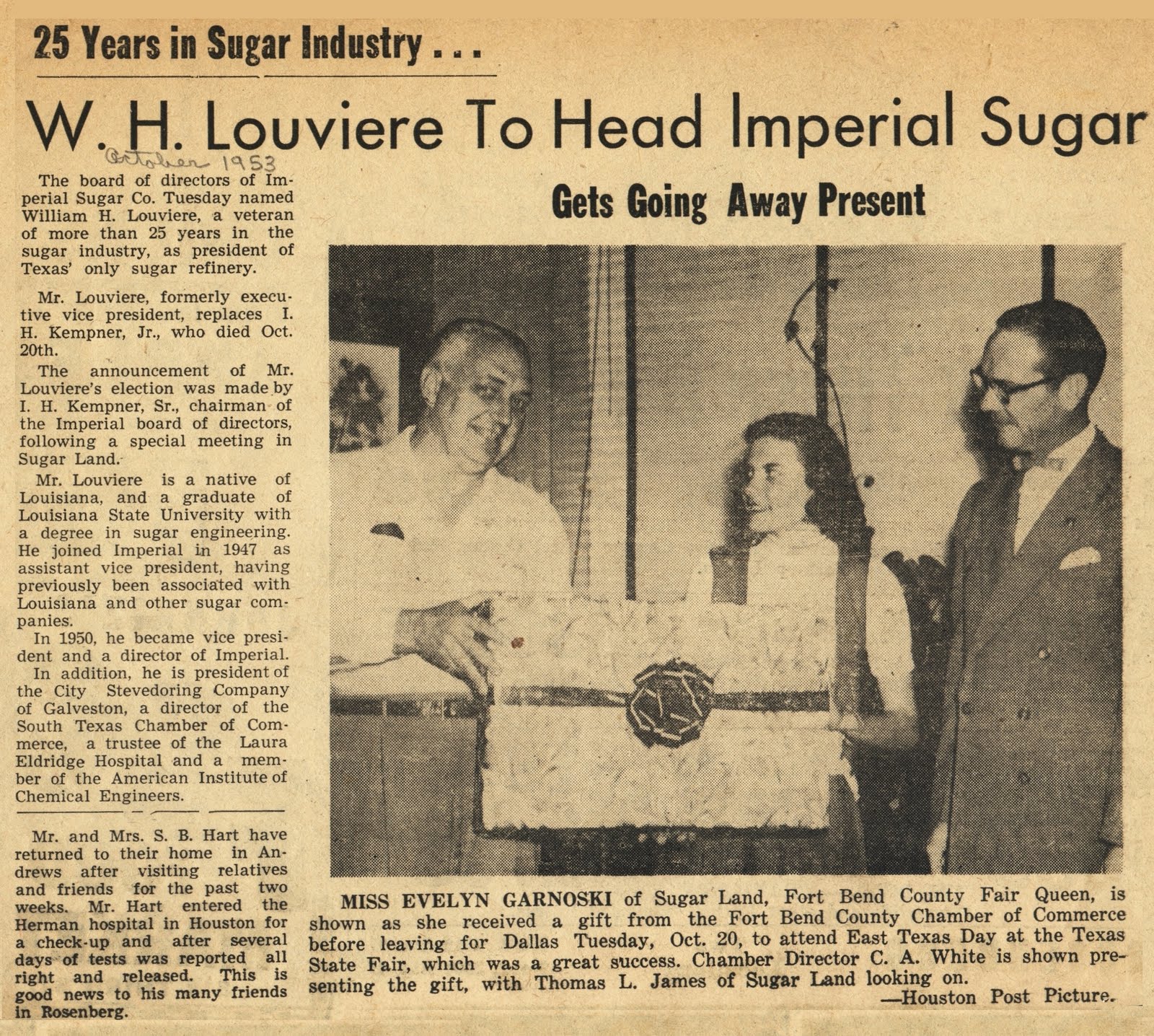
Article & Photo from The Houston Post - October, 1953


My thanks to the Chuzzy Jenkins family for this scan of an article & photo published in The Houston Post in October, 1953. The article & photo aren't topically connected. The article announced W. H. Louviere's appointment to the Presidency of Imperial Sugar after I. H. Kempner, Jr.'s death earlier in the month.


The photo shows Charlie ('Cholly') White & Tom James presenting Evelyn Garnoski with a bon-voyage gift. She was that year's Fort Bend County Fair Queen & was soon leaving on a trip to the State Fair in Dallas.


Mrs. Moye


Dot Hightower's archive included this photo of Mrs. Moye (I never knew her first name) with Sweet Pea Gandy. I'll bet this was taken at a Quarterback Club event.


I don't know what her title was, but Mrs. Moye ran the Sugar Land cafeteria, which stands today on the campus of Lakeview Elementary. I'm uncertain about when she started & when she retired, but she was a lifer. I'm reasonably certain she continued working several years after the consolidation in 1959. She lived in a white, wood-frame house off Highway 6 - just west of where Hightower High School now stands.


Newspaper Article on 1957 Gator Band


My thanks to Dot Hightower & her daughter Scotty for this clip. Judging by the type face, it comes from the Texas Coaster published sometime in the spring of 1957. Read the article to the end, & you'll find out how Jim & Maxene Gary met.


Gas Explosion In Stafford - February, 1964


My thanks to Rick Kirkpatrick for this clip from The Fort Bend Mirror published on February 27, 1964. Several of my friends remember this event; we've compared recollections. I was in Sugar Land that night & remember hearing it and seeing a very bright glow in the east. I figured the world was coming to an end.


On the other hand we heard the roar from Meyer Speedway if the wind was blowing right.


Thursday, March 17, 2011

Sugar Land Telephone Book (June, 1960)


The Helmcamp family had this copy of the 1960 phone book, which they let me scan. I'm grateful to them because the phone book is a good resource to determine where people lived.

I'd like to find a phone book from the early-to-mid 1950s, which shows the operator-assisted numbers - the "number please" era. I know I've seen one in the last few years.

Link to 1960 Sugar Land Telephone Book

In case you missed it, here's a copy of the first Sugar Land telephone directory from 1929.

Tuesday, March 15, 2011

Dulles High Band Videos


I thought some of you may have missed these band videos made for last year's 50th anniversary of the Dulles High Marching Band. I think my brother Bruce made all of them, or nearly all of them. They are all short - just a couple of minutes long.


In this first one he narrates a short history of the Band.

Link to video of Viking Band History

This next clip shows a performance during the Edna game at Kempner Stadium in the fall of 1960. (It has no sound track.)

Link to video of 1960 band performance (Jim Gary, director)

This one shows a band contest in 1963 or '62 at Katy. I think it's probably 1963. I was a freshman in the band in 1964, and the music isn't familiar to me. (It's very faint, so you may want to turn up your volume to hear it.) Maybe another old-timer can settle the date question.

Link to video of 1963 or '64 band contest performance (Jim Gary, director)

Here's an undated clip from the very early '70s showing a band lead by Dulles High's second band director, James Larson. Note the change in marching style. (Sound track added.)

Link to video of 1970 or '71 band performance (James Larson, director)

This clip shows a band led by the third director at Dulles, David Lambert, who was Jim Gary's son-in-law.

Link to video of undated band contest performance (David Lambert, director)

The next video shows the band led by Bill Duggan, Dulles High's third director.

Link to video of 1985 band contest performance in Alief's Crump Stadium (Bill Duggan, director)

This final clip shows a more current clip of the band led by Joe Pruitt, the current (4th) director.

Link to video of 2007 band contest performance at Mercer Stadium (Joe Pruitt, director)

Gator Boys Basketball Game, 1958


Fred Melton, Jr. lent me a box of old Dulles & Sugar Land game films a couple of months ago. All but two of the 25 reels were Dulles football & basketball games from the 1960s. (I'll post a complete list in a couple of weeks.) One of the other reels is film of the '52 Sugar Land vs Hempstead Regional Championship football game. I'm having it digitized now. More on it later.


The other reel shows a Sugar Land High School boys basketball game played in 1958. I can't identify the opposing team, but it was a home game (i.e., played in the gym located on the Lakeview Elementary School campus).

Here's a short clip. The entire film is 18-minutes long. Some of you have already contacted me about a DVD of the entire film. If anyone else is interested, email me or post a comment on this blog, and I'll send you more info.

Link to video

Bob Armstrong


I want to thank Jackie James for sending me this information on Robert M. Armstrong. I won't say a lot about his life because I've included a good obituary in this entry. Those of you who knew him will remember him as an exceptional man. If you didn't know him, you'll get an idea of his character from the obituary & statement of faith.


If you haven't read his history of Sugar Land, I recommend it highly. I think it's out of print, but you may find copies on eBay or at your local branch of the Fort Bend County Library.

I've included two pictures of Bob. The first comes from 1959 and shows a publicity photo for local newspapers. Imperial was celebrating a record number of days without an industrial accident. Bob is on the left. Robert Laperouse (left) & T. C. Rozelle (right) pose with him.

I don't have the date for the second picture, but it must come from Bob's retirement years. He was still involved with Imperial after he retired as company President.


Link to Bob Armstrong Obituary


Link to Bob Armstrong Profession of Faith

Sugar Land Motor Company


An earlier post provoked some questions about the Sugar Land Motor Company. The principal question was its various locations over the years. Bruce had an article that appeared in an edition of The Fort Bend Mirror printed in 1956. The newspaper was celebrating the 4th anniversary of Sugar Land's 'new' shopping center. They included stories about various enterprises, including the Motor Company.


Bruce also had a couple of Sanborn maps showing the town's layout in 1913 & 1926. The Sugar Land Heritage Society has several maps covering the town's development over many decades. They were made for insurance purposes, so they show good detail about various buildings. I think they are fascinating.

The 1913 map doesn't show the south side of the Highway, but it does show a building labeled 'Auto HQ' at the front of the refinery adjacent to Oyster Creek. This may have been the Imperial/Industries motor pool. (No commercial enterprise existed at that time.)

The 1926 map shows the Motor Company on the south side of Highway 90A roughly where The Palms Theater stood. (Gus describes the building as a corral.) Note the structure labeled 'Filling Station.'

As the article says, the Motor Company (including the filling station) moved to the southwest corner of Brooks Street & Highway 90A in 1941. You'll get a good view of this location in the photo on the cover of the Texas Food Merchant. (Click here.)

Link to an image of Gus Stabler's article in The Fort Bend Mirror

Link to a text version of the Stabler article

Link to 1913 Sandborn Map

Link to 1926 Sandborn Map

Bill Sterns Sports Newsreel


I listen to a lot of old radio programs and came across Bill Sterns. I don't know if he was ever on television; if he was, I don't remember him. You don't have to be a sports fan to find amusement in his hyper-animated delivery. I wish I could find the program in which he profiles the American miler, Glenn Cunningham. You wouldn't believe how worked up he gets telling that story.

I think this program aired in either 1945 or '46.

Link to audio of Bill Sterns program (15 minutes)

Volunteering & Priscilla Coleman Harden Article


One of my classmates, Priscilla Coleman Harden (DHS '68), is very involved in local volunteer & charity work. I wanted to give her (& volunteering) a boost by posting the article below. You'll see several worthy charities with which she's involved.

I know of several civic & historical groups who'd also appreciate volunteer help. If you have some spare time and want to do something useful, send me a note or post comment on this blog, and I'll give what info I have.

Link to newspaper article

Construction of Sugar Land Gym in 1932


I borrowed these pictures from Mark Schumann. They show construction of the school gym, now part of Lakeview Elementary. They start with the ground-breaking ceremony performed in 1932 (I think). The two men in white suits are W. T. Eldridge (with hat & sun glasses) and M. R. Wood. Mark has labeled Mr. A. H. Weth on the far right. I recognize Gus Ulrich who is standing in front of the women in the picture. He's wearing dark trousers, white shirt & tie, but no coat. I can't recognize any of the women.


The photos show construction of the gym in its first configuration. The basketball court ran east-west parallel with the swimming pool & was half the size it is now. There was a small set of stands in a gallery along the south wall of the building. You'll see it in the last photo, which comes from the '53 yearbook. When the high school was expanded in 1953, the gym was extended southward to create its current configuration. (The basketball court was rotated 90 degrees so it ran north-south, as it does now.)

Link to slide show

Texas Food Merchant (April, 1951)


My thanks to Shirley Laird for lending me this copy of the Texas Food Merchant magazine, which features Imperial Sugar Company. It describes Imperial in the early '50s & includes several good pictures, showing refinery operations, the Imperial Quartet, the sales department & company management.


The link below will take you to scans of the magazine pages. You can enlarge them if you want to get a closer look at the pictures or read the text. When you get to a page you want to enlarge, click the magnifying glass icon near the upper-right corner of the image. Pan & scroll the image by holding your mouse button down and dragging the image. Close the magnified image to move to the next page.

Texas Food Merchant (April, 1951)

Tuesday, February 22, 2011

Char House Construction Photos, 1925


I worked with a team of Sugar Land Historical Society volunteers this past weekend at the Imperial Refinery site. Johnson Developers were kind enough to let us look through the rubble for 'souvenirs.' We got to look in the Char House, which reminded me of these pictures which Mark Schumann had posted on Facebook. He kindly let me download & post them here.

I don't know much about the Char House construction project in 1925. Mr. A. H. Weth was chief engineer at Imperial. I presume Imperial hired a construction firm to build the Char House, and Mr. Weth worked with them very closely. I don't know if these were his personal pictures or not; regardless, they are fascinating to me.

The link below is to a Picassa Slide Show. Put your mouse button over the pictures to display a control panel that will let you pause the automatic page change. Mark has provided good captions for many of the photos.

Link to Slide Show