Drop Down MenusCSS Drop Down MenuPure CSS Dropdown Menu

Tuesday, March 29, 2016

More People of Old Sugar Land


My thanks go to Debbie Batten Dunlap for posting this photo of her mother, Barbara Batten on the right, and her mother's sister, Mollie Williams on the left.  I'm sorry to report that Debbie's Aunt Mollie died recently.  My parents and I had the pleasure of visiting Mollie, her husband Bill, and their daughter Lara on a trip to Dover, England in the late 1970s.  We had a wonderful day.  To add to Barbara's misfortune, I understand she's been in the hospital recently.  Here's hoping there's a bright day coming very soon.


Some of you may have heard that Wayne Boehm has been in the hospital recently.  I want to thank his daughter, Jennifer Boehm Kocich, for keeping us informed and posting some photos on Facebook.  The first one appeared in The Imperial Crown, I think, and it shows him in the refinery lab.

  
Jennifer posted the next two, showing Wayne when he was in the US Army.


I'll never forget something Wayne said in an interview a few years ago about playing football at Sugar Land High School.  The interviewer asked, "What was it like playing guard in the Notre Dame Box?"  (The ND Box was a rare offensive formation the Gators used back then.)

Wayne said, "If you played the guard position in the Box, you had to be mean, fast, and dumb."  He laughed when he said that, and I still think it's funny. 

Another bit of bad news: Maxene Gary, my 1st grade teacher shown in our class photo from 1957, fell and broke her hip recently.  She's doing fine and rehabbing her way back to normality.  Hope she gets well very soon.
 
  
I think Robbie Harrington Raska posted the next photo on Facebook.  It shows her mother, Dot Powell Harrington, Judy Harrington Diamond, Kathy Harrington Spillers, Robbie, and Dot's granddaughter. I don't recall whose daughter she is, but I know she's a Harrington.  I think they were trying to decide if was time for plastic surgery.  (I don't think so.)
  
  
The next article came from The Imperial Crown issued in May 1955. It spotlights Lee and Delia Townsend.  Notice Lee was born near Clodine and attended Pleasant Green School, which predated M. R. Wood by several years.  Also notice he maintained the goldfish pond, which was a regular stop for me when I visited the refinery as a child.  (It's still there by the way.)
  
    
I found this article spotlighting Bud Jenkins in the June 1955 of The Imperial Crown.  The Kellys were neighbors to the Jenkins family when we lived on Guenther St. in the 1950s.  I grew up with Darlene, Belinda, Betty Ann, and Denise.  We had a ball in those days.
 
  
The next photos come from Ernie Wood's photo archive.  I'm not exactly sure about identifying everyone, but I recognize quite a few people.
 
Date & location are unknown to me, but that's Ernie, Bob Armstrong, Tom James, and (I think) Lou Armstrong.  I don't know the young girl on the floor.

I've posted this before.  It shows a fundraiser for the First Presbyterian Church.  L to right: Bob Armstrong, Ernie, the church pastor, Dolly and Kenneth Landin.

I'm reasonably certain that's Herbert Helmcamp, Lou Armstrong, and Ernie on a cruise.  That's the only photo of Mr. Helmcamp I have.

An undated photo (1980s?) of the Lee Shelton family.

An undated photo of the Shaw family, who lived out on Flanagan Road near the Friersons.  Mr. Shaw was a prison system employee.  His son Glen was in the Class of '67 at Dulles.

This is a photo of SLHS's Class of 1950.  They look sort of tough to me.

Commencement program for the Class of 1950 1952.(Oops, I posted the wrong program.)

Commencement program for the Class of 1950 1952.(Oops, I posted the wrong program.)

An undated photo (1970s?) of the Pamplin family.  (Thank you Vivian Pamplin Dimmock.)

More Images of Old Sugar Land

 
The following article appeared in the November 1956 issue of The Imperial Crown and noted the demolition of two old buildings.  The first housed Sugar Land's meat and produce markets, but before it served those purposes, it was the town's saloon and gambling house.  I think Kempner & Eldridge repurposed it soon after they took over the Imperial Sugar Company and Sugar Land in 1908.

Here is a panoramic photo showing the building when it housed the town's meat and fresh produce markets.  It's the two-story structure in the center of the photo.  You can see the old tailor shop and shoe shop on its left.  That building became Sugar Land's first city hall in 1959.

Sugar Land's west side in the 1920s.

The article mentions that the old Marshall Canning Plant (earlier it was the Sealy Mattress Factory) was torn down at the same time.  Here are a couple of photos of that structure, which stood on the northwest corner of Main & Kempner Streets.

I found the following undated photo of Sugar Land's first drug store.  Sugar Land's first doctor's and dentist's offices were located in that building until the clinic at Ulrich & Kempner was built in the late 1930s.
 

More Imperial Sugar Company Photos


The first set of photos showcases Imperial's fleet of liquid sugar trucks.  Of course, Imperial delivered liquid sugar by rail tank cars, too.  Click on the image below to view the photo album. (Click the 'I' icon in the upper right of the images to view their captions.)
 
 
The following photo album shows Imperial's Raw Sugar Warehouse and Melt House operations.  I have not labeled the photos individually, but you'll see that handling raw sugar was definitely a bulk operation.  Click the image below to view the photo album.
  

Miscellany


This first item is roughly a month late, and the image quality isn't as good as I'd like it to be, but I saw this map on Facebook and thought it was informative.  It shows the Alamo as it looked in February 1836 with an overlay of modern streets.

As you can see, the Alamo was much larger than we imagine.  I think the State of Texas has acquired the land on the west side of the plaza where Ripley's is located.  I think their intention is to eventually reconfigure the plaza so it's closer to its layout in 1836.

I recently read Blood of Heroes by James Donovan and finally understood that the main entrance to the Alamo complex was on the south side, where Jim Bowie's room is noted on the map.  The other thing I didn't realize is that the main part of the battle did not occur at the west wall.  The north wall and east wall were the site of the most intense attacks on the final day.  An attack from the south and a late surge at the west wall occurred at the very end.
   
 
A fellow who posts photos on Facebook under the name Traces of Texas posted the following, which show Rollover Pass in 1957.  (The pass is on Boliver Peninsula several miles east of the ferry landing.)  

I never realized that Rollover Pass got its name from smuggling.  The pass was a strip of land where the peninsula was at its narrowest.  Smugglers would land their boats in the surf and then roll barrels over the narrow spot and reload other boats with their contraband and haul it into Galveston Bay for distribution at various rendezvous.  Smugglers skirted customs at the Port of Galveston which patrolled the mouth of the bay between Galveston and Boliver.

Apparently, the pass was dredged on private land in 1955.  By 1957 it was a hot spot for fishing, as these photos attest.  Actually, it's still a good fishing spot, judging by the photos I see on Facebook.
 
Rollover Pass in 1957.

Rollover Pass in 1957.
Some of you may have read recently, that Schlumberger is moving its US headquarters out of Houston to Sugar Land.  I found this article in the September 1956 issue of The Imperial Crown, announcing Schlumberger's purchase of 1,300 acres of land in what eventually became Sugar Land's industrial park north of Highway 90A.

I had forgotten Schlumberger came to Sugar Land that long ago.
 
I could have sworn I saw Milkdrop Moe on Houston television when I was a child, but based on what I've found on the Internet, he was gone before I could turn on a tv set.  Here's what Earl Blair posted on Facebook:
  
Milkdrop Moe with Uncle Ned.
  
THE MYSTERY OF THE MISSING MILK DROP - I've been watching Houston television, off and on, since 1951. In those distant days, KPRC-TV was the only station telecasting blurry, black and white images to the rabbit ears perched precariously atop our 14" family Philco.

My very favorite Houston television personality from that time, was a large, talking milk drop -- yes, talking milk drop -- named "Milkdrop Moe."

Along with his human counterpart, Uncle Ned, Milkdrop's fifteen minute daily show basically served to introduce Crusader Rabbit animated cartoons and sell Sanitary Farm Dairies' milk. What could possibly provide a better endorsement of milk to a six year-old mind like mine, than first-hand testimony from a milk drop?? And one that peppered his salesmanship with a bounty of bon mots, to boot.

Noteworthy is fact that Crusader Rabbit was the very first animated cartoon series from Jay Ward, then partnered with the show's creator Alex Anderson, who later delighted television viewers with Rocky, Bullwinkle, George of the Jungle and dozens of other memorable animated cartoon characters. It was also the first cartoon series designed specifically for television. The initial episode—"Crusader vs. the State of Texas"—aired on KNBH (now KNBC) in Los Angeles on August 1, 1949.

Inside the cramped costume was talented comedian, Bobby Lauher (sometimes spelled Larr professionally). Lauher (1930-73) was born in Illinois, but grew up in Houston. A popular personality on KPRC-TV, he also teamed with Johnny Royal for that station's local comedy show, "The Guys Next Door." He found greater fame as part of Ernie Ernie Kovacs' ensemble and as a comedy writer providing laughs for Rowan and Martin and many others.

As memorable as Milkdrop remains in my mind, the show was only on the air for two years, 1952-53, and was a local Houston creation, which made finding memorabilia difficult. I located images of a badge and personal appearance flyer, but a photo of the pasteurized personality had proven elusive for decades.

That is, until this morning when, in one of my endless Internet searches, happened, purely by chance, to come across the below photo. Here, then, for all of you old enough to remember, is Milkdrop Moe and his pal, Uncle Ned. (See photo above.)

Monday, January 25, 2016

News & Updates


I regret to say that I have nothing but bad news to report.  Lou Payton (SLHS '46) passed away recently.  Click here to view an obituary article in the Fort Bend Herald

I attended his funeral a couple of weeks ago.  Here are scans of the service program.


I also regret that Earl Tise, Jr. (SLHS '43) died recently, too.  Here is an obituary.

Earl Tise, Jr. on the right with Ralph McCord and Sammy Norvic in front of the Sugar Land drug store in 1942.
 
My sincerest condolences go to the Paytons and Tises at the loss of their loved ones.

More People of Old Sugar Land

 
I've selected some images of Imperial employees who worked in the Packing Department.  If you look at the 1928 map of Sugar Land included in this same collection of blog posts, you'll see where the Packing Department was located.  It's labeled as the 'old warehouse' near Notation #2.

(Click on image to view album.)


I've also prepared an album of photos from The Log, Sugar Land Junior High's yearbook published in 1961.  The Vavrecka family donated it to the Sugar Land Heritage Foundation recently.  (Thank you, Janice Hartman.)

I'll post more of this yearbook in the future.  This time I've focused on the Dulles Class of '65, who were 8th graders back in '61.

I also want to point out the two photos at the end of the album.  The first shows a magnification of a building on the campus. (The one at the far right of the photo.)  Coach John Allen taught me 7th grade science in that building.  It was in use for quite a while.

My brother has suggested it was the two-room school house at Wood and 2nd St., which preceded the Lakeview campus constructed in 1918.  I think he may be right.  A few windows may have been added in later years, but the general appearance is the same IMO.

Miscellany


I found the following image of Curly Fox and Texas Ruby with their band at KPRC's television studio in the 1950s.  It was posted to the KPRC History page on Facebook, which is well worth a look if you're interested in the history of Houston television.  Obviously, Texas Ruby is the woman standing on the left.  Curly Fox is in the man standing on the far right.

  
My good friend and DHS classmate, Frank Lampson gave me a card on my recent birthday.  (It was my 66th BTW.)  It included a booklet with interesting facts about that important year.
  
(Click on the image to view album.)
 

Sugar Land in 1928


The Sugar Land Heritage Foundation has a remarkably good collection of old maps.  I've looked at a few recently, including this one showing the town as it was on August 8, 1925.  At least, that's the date on the map.

An aside: I'm not at all happy with the way Google handles large images.  I've wasted time trying to find an alternative, but have had no luck so far.  So, I'll just work with what I've got until I can find something better.  (On the positive side, Google's tools are free, but maybe you get what you pay for.)

The first image shows the old map in its entirety.  Unfortunately, Google doesn't provide a suitable method for showing it in high resolution, so the second image shows the areas where I've magnified portions of it.


The next image shows a Google Earthview of the same general location today with annotations of the magnified areas.
 
 
Here is the first magnified zone.  It shows the western edge of the town in 1928. Notation #1 shows Sugar Land's dairy, which included a barn and a 'milk house.'  Notation #2 indicates a 'hay barn,' which I assume was part of the dairy.  If you look closely you can see a bridge over Oyster Creek, not far from the one for modern Imperial Blvd.  The dairy's cows walked over that bridge to graze in the pasture that is now home to Constellation Field and the new Imperial subdivision.  Notation #3 shows the bulk fuel station.  I never knew it was in operation as early as 1928.
 
 
Notation #4 shows the lumberyard.  (I recently posted a photo of Hugh Charleton standing in front of that building at the time of his retirement in the 1960s.)  Notation #5 is labeled 'work shop,' but I always heard it referred to as the 'labor office.'  I didn't know till much later that there was an apartment in the 2nd floor of that building.  Nation #6 shows the cotton gin, and as you can see from Notation #7, Visco (eventually Nalco) didn't exist in 1928.  According to company history in began in the early 1930s.  I've seen a photo of the original shed where it all begin.  I wonder if it was the one labeled 'cake house.'  The one labeled 'potato house' is too large.

The next magnified zone shows the refinery complex, but the first thing to note (#1) is the building labeled 'new sugar house & cane mill.'  It shows Imperial's last raw sugar mill, which closed in 1928.  Although it is 'new' per this map, I think it was actually built by Edward Cunningham in the 1880s or '90s.  I believe the building labeled 'wash plant & melter' (near # 5) was an older sugar mill (later repurposed for other uses), but Leon Anhaiser (and others) may have more certain info on this question.

The image immediately below shows the last cane crop processed at this mill in 1928.  The camera was pointed east at the spot where I've put Notation #1.  Annotation #2 shows the 3-Bay Warehouse which still stands and will be part of Imperial Market.  The structure labeled 'old warehouse' was actually the Packing Department (I think).  That building and everything to the east of it has been demolished, as you can see in the Google Earthview.  Notice #3 indicating the 'feed mill.'  I always thought it was near the cotton gin, but this map shows it was located where the Distribution Warehouse stood, which was recently demolished but still visible in the Google Earthview image.  Notation #4 shows the 'cooperage,' or barrel-making/repair shop.  I assume Imperial still shipped sugar in wooden barrels in 1928.  It certainly did in the very early years.

Annotation #5 identifies the Char House (constructed in 1925) and W. T. Eldridge's old home beside it.  Eldridge moved to his last home on Lakeview in 1928 - it is labeled as a 'restaurant' on this map.  Notice at #5 that the back of the Mercantile Store housed the railroad office.  The bakery had a separate oven, as shown at #6, and the barbershop was in the same building as the bakery.

The 'meat market,' 'tailor shop,' and 'shoe repair' are near #7, as is the depot.  Across Highway 90A (which is labeled Highway No. 3) at #9 is the service station and mule shed.  

As #8 indicates, the Sealy Mattress Factory was gone and the building housed a 'fig factory.'  The fig business was a serious disaster for Sugarland Industries not too many years later.


The east side of town appears in the last magnified image.  Notation #1 shows the Salvage Building, which housed multiple departments, but notice the 'printing plant.'  It printed the Texas Commercial News, Sugar Land's local paper which I've mentioned frequently.  The area around #2 shows a 'hemp plant,' which I assume made bags, and two other buildings for servicing trucks (I think.)  The old John Deere maintenance building hadn't been built in 1928.

One last item: notice the erasure just north of the Salvage Building.  I think someone removed traces of the old Sugar Land Railway yard: the maintenance shed, roundhouse, and sidings.
 

We have numerous photos that supplement this map.  I'll post some of them in the future and use this map to orient what they show of Sugar Land's past.

Part 4: Ginning Cotton


This is the last in my series of posts about cotton, which is still a major crop in Fort Bend County, but not so much in its eastern half.  Until roughly 40 or 45 years ago, raising cotton was a significant part of Sugarland Industries, but once its land was sold off and the corporation dissolved, cotton was no longer part of our community.

Someone will have to help me with this, but the cotton gin (see images below) was shut down several years before the Industries dissolved.  I don't have a clue about the precise date.

The following article appeared in the August 15, 1925 issue of the Texas Commercial News, Sugar Land's local paper at the time.  The article goes into detail about the crop, the gin, and the condition of the '25 harvest.
 
 
Sugar Land's gin was located where the east end of Nalco's plant stands today (where Ulrich St. meets the railroad tracks).

The first two photos are blow ups from the third, which shows the gin in the 1920s. Note the mules and wagons.  I assume the large sacks are filled with seed.  (See the article above about processing cotton seed.)


The next photo was taken a few years later, I think.  (There are no dates on any of these photographs.)  As best I can tell, the hexagonal building on the right with the cupola doesn't appear in the earlier photo.
 

I've posted the next image before, but I've used it again to give an additional perspective of the gin.  (This image is also undated, but it's probably a scene before the '20s.)  The wagons in the foreground are parked in front of old The Red Barn Cafe's location a few decades later.  I've magnified the photo for close inspection, and I can't see any indication of a crossing where Ulrich St. should be.  If you looked closely at the previous post showing the 1928 map of Sugar Land, you saw Ulrich St. clearly marked, so this photo must be earlier than 1928.
  
This last photo is obviously modern, and it shows the gin in Crosbyton, east of Lubbock.  I've included it because it contrasts a modern gin with the one shown in the images below.  Those are cotton modules, which I've discussed in earlier posts, lined up beside the gin.  They may be hard to see, but in the distance on the right you can see two module haulers.  They look like boxcars.  One is tilted upward.  They are the modern version of the wagons you see in the image immediately above.
  
 
A friend found this short slide show which shows a gin in operation in Alabama.  Click this link to view the video.

Sunday, January 3, 2016

News & Updates


First, some sad news for members of the Class of '68 at Dulles High School.  Our classmate and class president, Henry DeLeon died on December 29th.  Click here to view an obituary.   I think Henry was a life-long resident of Arcola, although I'm not absolutely certain if he lived elsewhere in his later year.  Henry was a good guy, and my condolences go to his family.


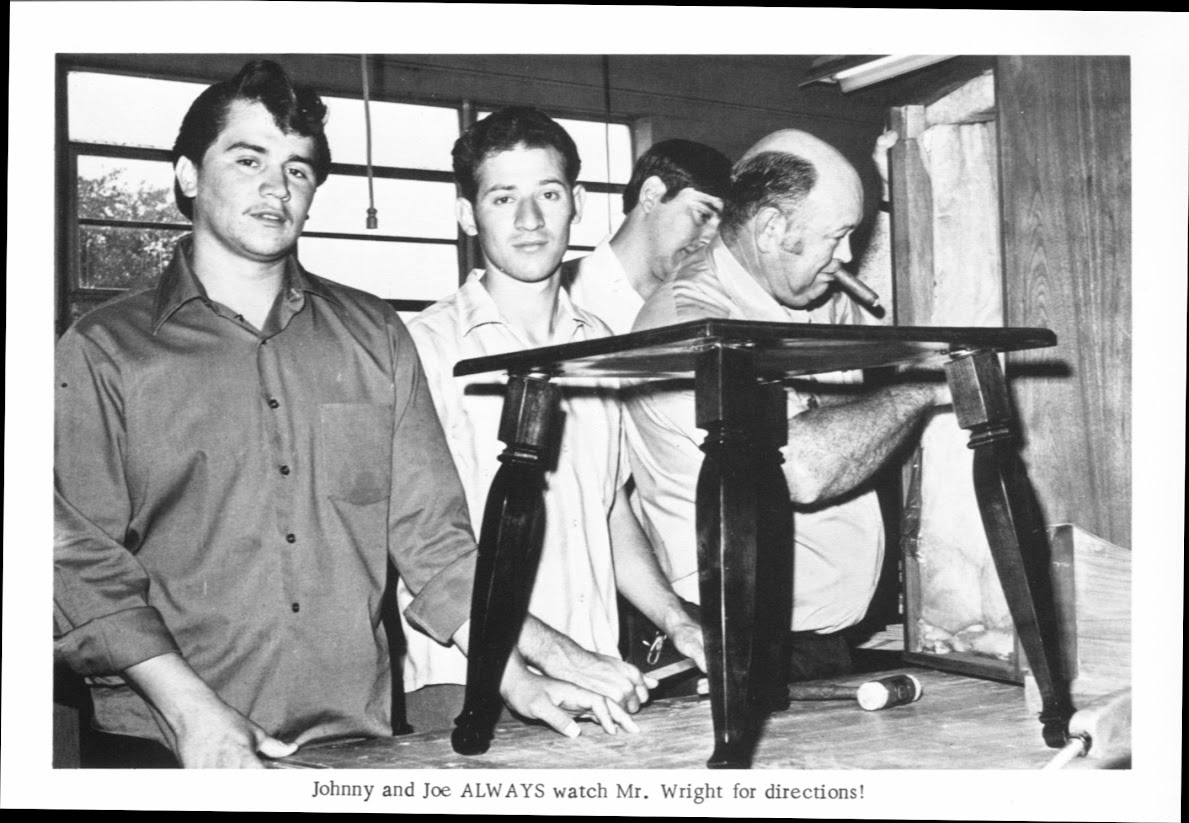
On a brighter note, I want to report some info on Mr. Billie Wright.  My thanks to Jon Pitts (DHS '61) for informing that Mr. Wright was taken prisoner in the Philippines and became one of the 'Battling Bastards of Bataan.'  Like Buster Court, he survived the Death March.  Jon told me he had shrapnel wound on his right leg and sometime showed them to his class.  [David Wickersham (DHS '63) mentioned Mr. Wright's extraordinary experiences in WWII, but I didn't realize they included Bataan.]

I've tried to research him on WWII POW lists, but I haven't had much luck.  Apparently, records for the Bataan prisoners are spotty because many of them escaped and hid for extended periods of time.

I thought the following story from Travis Gandy (DHS '64) was hilarious.  Here's what Travis said:

Hey Chuck,
Boy, do I remember Mr. Wright. My rear end felt that board many times in shop class. I remember when you got in trouble with Mr. Wright, he would take that board to you (and you probably deserved it), but he would also line up the "whole cheese" (that is what he called the entire class), and they got licks also. I remember when I was in the Air Force and came home on leave, I went to school to visit in my uniform, and I went to Mr. Wright's class. He lined up the "whole cheese" just because I came to see him, and I got a lick for old time sake.
  

Sugar Land Elementary Photos


There's a Facebook group devoted to Lakeview Elementary.  I've stretched their scope a bit to show photos of elementary schools preceding Lakeview.  

The first photo shows the school that existed before the Lakeview campus was created in 1918.  This one-room school was located at the northwest corner of Wood and 2nd St. Old timers know the house now on that lot as the M. R. Wood home.

1918.

The next photo shows the Sugar Land Elementary School's first grade class in 1925 1931. My father, C. E. Kelly, Jr., is the boy standing at the far left on the back row. 

 
1925 1931 first graders.

School buses looked a lot like armored cars in the old days.
 
An undated photo (probably 1930s or '40s) of a Sugar Land school bus.

The next photo shows the Hispanic School located on Ulrich St., just north of the new bridge over Oyster Creek.  I don't know the exact dates when the school operated, but I think it was still in operation into the 1950s.  My understanding is that it was bi-lingual and encompassed the first through fourth grades.

This building also served as headquarters for the Freeman Post of the American Legion before the current building was constructed in the late 1960s.
  
An undated of the Hispanic School in Mayfield Park.

The next image is of the Lakeview cafeteria when construction was completed in 1953.

1953.

The next photo comes from the Fort Bend Mirror and takes the biggest stretch. Although these boys aren't shown at Lakeview Elementary, I'm certain most, if not all, of them were students there.
  
1968.

More Dulles '71


I've selected a few photos from the 1971 Dulles Viking yearbook.  As you can see from the image below, I found a photo of Mr. Billie Wright with a cigar in his mouth.

The other photos show award winners in Distributive Education, Music, Cosmetology, Agriculture, and Literary/Debate/Creative Writing.  (BTW, nerds rule!) 
 

More People of Old Sugar Land

  
The photo was taken in 1961.  I'm fairly certain this man's last name is Shelton, but I'm having trouble determining his first name.  As you can see, he maintained the area at the plant entrance beside the Char House. (Maybe someone can provide his name.)


The next photo shows Hugh Charleton at the time of his retirement in 1965.  I'll have to research this, but I think he was a foreman for Sugarland Industries.  Note that he's standing in front of the old lumber yard on Imperial Blvd., roughly where the east end of the Nalco Plant is now located.
 

This next photo shows summer hires, Ollie Scott, Jr., Richard Sister, and Jack Nygren as they earn their pay in the Char House.  I think this photo was taken in 1963.
 

More Images of Imperial Sugar


This album contains more photos of Imperial Sugar.  (All come from the Sugar Land Heritage Foundation's collection.)

The first five show the Distribution Warehouse when it was constructed in 1969.  Those of you who've visited the Farmer's Market recently know the warehouse has been demolished in preparation for Imperial Market development.

The next 4 photos show the 'new' Machine Shop completed in 1965.  It is also gone.

The remaining photos show activity in the Shipping Department.  You see how refined products were stacked and loaded into train cars and truck trailers in the old days before the Distribution Warehouse was completed.  It had automated palletizers which meant  finished products would be stored and transported with minimized manual labor.

Note the last 3 photos.  The first is a very early photo of a shipping laborer stacking product in the 1920s.  The next shows the automated palletizers in the Distribution Warehouse.  The last photo shows the 10,000th carload of sugar just before transport.  I'm not sure of the date, but I think it was in the late 1960s or early 1970s.  (I should be able to determine the date from the SLHF's copies of The Crown.)

Click on the image below to view the album.
  

Historic Photos of the US


I want to thank several readers who sent me this album of very high quality photographs scenes in the US more than 100-years ago.  I'm not an expert on the history of photographic technology, but I think these photos are astoundingly crisp because photographers in those days used large box camera, which employed very large negatives.  Essentially, there was a lot of space on the negative to store a lot of pixels, to use modern vernacular.

I also want to point out that whoever collected these photos took some from Shorpy's a very, very good Web site for old photos.  I recommend it highly if you are interested in this kind of stuff.  Click here to go to the Shorpy Web site.

Click on the image below to see the album. Just a lot about Google Photos.  I put captions on the photos giving their dates and locations.  Just click on the 'i' icon to display them.

Wednesday, December 23, 2015

News & Updates


I have a news item of interest to Dulles alums.  I got it from Tracy Prater, who is married to Dulles alum and a Dulles teacher, Roberta Cooke Prater.  It's a live musical event supporting the Dulles Graduation Project.  The date is Monday, January 4, 2016.  Here's the info Tracy sent:

The first Monday of 2016 will be a rare and wonderful evening:


2. Superb pub food and beverages - your tab is yours

3. Texas troubadour, Shake Russell closing the show and collaborating with:

4. Dulles High School (DHS) students, alumni, family and friends performing 5 decades of acoustic hits

5. All in support of DHS Project Graduation, a long standing 501c3 organization which funds a safe, fun, all night after graduation lock in celebration for the seniors (at zero cost to them).

If you, family and friends can join us, grab your $15 reserved seat tickets online at the Duck as soon as possible (only 100 seats a the Duck)

If you cannot, please consider funding our efforts with the ticket price online at GoFundMe.

Either way, please follow us on Twitter and Facebook.

 Sounds to me like a lot of fun for a good cause.  (I wonder if Shake would let me do my rendition of "Love Sick Blues?"  Probably not.)

I have a couple of updates relating to Mr. Billie Wright and his paddle.  I guess we're on a Dulles theme this time.

The first is from David Wickersham (DHS '63).  I had no idea Mr. Wright was a WWII vet.  Maybe we can find out more about his service history.

Hi Chuck, great post. Always enjoy going down memory lane. I was one of those who were blessed to receive lessons from Mr. Wright's BOARD OF EDUCATION. He actually had several paddles of different design and was always ready to test a new design on a volunteer from his shop class. I regret that I did not learn that he was one of the Heroes of WWII when I was in his class. He was a good man and if he gave a swat, you deserved it. Who knows what would have become of us without the guidance from him and others like him of that generation.

This next amusing anecdote comes from Janice Jenkins Girard, my classmate (DHS '68).  Unfortunately, I have lost the message, but I remember the story.

Janice's first husband was Bill Gremillion, also DHS '68.  He was a shop student, who broke Mr. Wright's rule about smoking.  The routine punishment was a number of licks (as we called them then) commensurate with the number of letters in the brand of cigarette you were caught smoking.  If you smoked 'Kools," you'd get 5 licks.

Well, Bill thought he'd finesse the system by saying he was smoking an L&M cigarette.  Unfortunately for Bill, Mr. Wright saw through the ruse and spelled out 'Liggette & Meyers' on his butt.  Kids don't know what they're missing these days.

Christmas Reprise