Drop Down MenusCSS Drop Down MenuPure CSS Dropdown Menu

Wednesday, August 24, 2011

1940 Dodge (Mint Condition) Found in Barn


Some of you may have seen these photos, but I thought they were worth posting for those who hadn't.  The explanatory text is very good, so I can't add anymore.

***************
Hidden for Half a Century: The 1940 Barn Dodge!

You have heard stories of barn finds before. Some sound incredible, some unbelievable. But here's one that might top 'em all. It's the true story of one 1940 Dodge Deluxe Sedan.


Back in 1940, life in the Country was running at a different pace. You could leave your house unlocked, and, of course, your car. Television and graffiti were words without meaning. Pearl Harbor was an event of the future. It would take two more years until the United States would enter World War II.  Life was hard but good ...


At about this time VIN *30231403* was built by proud American workers in Detroit, Michigan, one of 84,976 Dodge D-14 DeLuxe four-door sedans manufactured in 1940. A veterinarian from Horseshoe Bend, Idaho, purchased the blue Dodge new at the local Dodge dealer in Boise . He used it to respond to calls all through the war years; his 1944 permit is still affixed to the windshield. Being a very valuable asset during war times, the car was always parked in a dedicated spot in the barn when not in use. In 1948, the good Doctor passed away. The car was put on blocks and covered with bed sheets. No, it was not going to be for sale. Who would have guessed at that time that the Dodge would be asleep for more than 50 years ...


Children became adults, parents, then grandparents. The old Dodge was still slumbering in the barn. In the late 1980s an attempt was made to awaken and sell the car. Finally, early in 2003, the time had come. The bed sheets were taken off, the car was lifted from the blocks, and the tires were filled up with air. A new owner was found. He took the Dodge to Southern California.


63 years old and with only 42,342 original miles showing on its odometer, this Dodge personifies the term "reference car."  More importantly, it represents a rare opportunity to experience how it felt driving a new car in the 1940s.  Time to start our little journey around this amazing Dodge ...
 

The body, amazingly, is straight and absolutely rust free, thanks to being stored in a dry, well ventilated barn, away from the elements. The blue lacquer paint is original, factory applied. Sure, it's worn thin on the tops of the fenders, shows a myriad of nicks, imperfections, and touch ups from the past. There are a few small dings here and there, but not an ounce of body filler nor a single rust bubble. It's all heavy metal! Repainting this car--ever--would be an unforgivable sin! Its patina is irreplaceable and gives the Dodge its inherent value. 


Another Dodge industry first & for 1940: safety rims! The wheels still feature their factory triple pinstriping, the heavily chromed hubcaps are beautifully preserved. Even the painted red detailing is still intact! Bias ply tires of the dimension 6.00x16 look original as well. I don't think they make "Pennsylvania Rx Supertest Cord S-3" rubber anymore ...
 

Open the doors and be invited into a cabin that's 100% factory original. Unmolested, unmodified, unrestored. It has the special 1940s aroma and charm that cannot be duplicated. It should never be restored, instead be enjoyed just the way it is.
 

Dashboard is a masterpiece of Art Deco design. Fabulous painted metal creates the ambiance of lightly stained wood. Nickel plated accents duplicate the look of then-popular costume jewelry. Every single part seems infused with the designer's idea to create a harmonious environment; details such as the retracting ash receiver lid are simultaneously good-looking and functional. There's simply no comparison to present-day throwaway products, sprouting black plastic appendages everywhere. Nevertheless, the Dodge was built with entirely modern creature comforts. It features dual electric windshield wipers, Sealed Beam lamps, floating power, hydraulic brakes, telescopic shock absorbers, a column-shifted, synchronized transmission, tinted glass, a chromed horn ring, and a host of other innovations.


What was found in the felt-lined, locking glove box is nothing short of astonishing in its historical context:
  • Owner's instruction book in its original envelop e
  • "Sentinel" first aid kit, incl. a bottle of "Mercuro-Chrome"
  • Small upholstery brush
  • Promotional lead pencil "Compliments of DeRail Pool Hall, Glenn's Ferry ID"
  • Old bottle opener
  • Parking stub dated 8/16/1941, from the " Glen Valley Rodeo"
  • Small metal box containing "Buss Auto Fuses"
  • "Ideal Split Shot" box containing a tire valve and a fishing hook
  • Pair of celluloid sunglasses
  • "Travel Idaho with CONOCO" road map

       
    Ample space for three on the comfy front bench, featuring "airfoam" seat cushions. Original mohair still looks good, with the unavoidable stains and moth attacks kept to a minimum.


    Through large, rear-hinged suicide doors, entry to the spacious passenger compartment is easy, even when wearing a top hat. Luxuriously equipped with arm and foot rests, woven grab handles, beveled-glass interior light, and (unused) ash tray, passengers will invariably exclaim: "This feels like Driving Miss Daisy!"
     

    Roomy trunk sports original jute mats. Original spare wheel and jacking equipment are present, as well as some spares and a small tool tray. Also included is a set of new GOODYEAR tires of the proper size and a set of new inner tubes. We did not feel the need to mount the new tires, however, it might be advisable before embarking on an extended journey. 

      
     A beautiful classic car, ready to be of service!


    "Let us MARFAK your car!" proclaims TEXACO's old service sticker on the door jamb. Dodge was just lubed and serviced, 2,000 miles ago, in 1948. Note the carmine-colored, bakelite knob, Dodge's early version of power assisted steering.


    Art deco trim
    Cloisonne emblem
    Firewall tags
    Rear vent window
    Above, clockwise, from top left:

    • Art deco headlight bezel with glass parking light lenses
    • Unmarked rubber floor mat and pedal pads, irrefutably confirming the car's low mileage
    • Original heater below dash
    • Rear vent windows open wide
    • Art deco door handles and stainless side trim 
    • Dodge Brothers tags on firewall
       

      Engine compartment is clean and original as well. Dodge's 217 cu.in, 6-cylinder engine was good for 87 lively horsepower. It starts instantly and runs like the proverbial Swiss watch. Items recently replaced or serviced include the battery, water pump, ignition wires, spark plugs, fuel tank, carburetor, brakes, and shocks. Original honeycomb radiator core looks gorgeous! And, yes, the horn works, just like everything else on this time machine. 

      Amazingly intricate, heart-shaped grille presents itself in outstanding condition, with brilliantly sparkling chrome. Bumpers and over riders are beautiful and functional, too. Car's brightwork appears excellently preserved throughout. Note the wonderfully maintained running boards, which were optional on the 1940 models. So, what's it like driving a 71 year old Dodge?

      Very impressive, thank you very much. Turn on the ignition--with the original "CDPD" key--and press the foot knob for the starter. The engine comes to life instantly, idling almost inaudibly. Pull the gear lever down into first, release the clutch, and you'll pull away smoothly. Everything is smooth about the Dodge. Suspension and brakes transmit a safe and sound feeling. Acceleration is brisk, at least by 1940 standards. All the gauges work. Oil pressure is great and the car runs cool. In a nutshell, it's a delightful cruiser! Even the PHILCO radio still hums when turned on; it seems the speaker cone needs replacing.
       

      All this car needs is one appreciative caretaker. It's a very rare find and definitely a "keeper" for the right Dodge enthusiast.
       

      Best of all, it's a true rust free, low-mileage Dodge that could even be used every day, if you so desire. There are not too many 71 year old, original cars in this Country that could make this claim!!
       

        Tuesday, August 16, 2011

        The Palms Theater


        Here are some images relating to The Palms Theater.  I've posted a couple before, but I thought I'd put them all together in a set.

        I think you'll be able to determine the theater's location from the photos.  If not, it was located on the southeast corner of Highway-90A & Ulrich Street.  (Roughly a few yards west of the parking lot in front of Imperial's current headquarters building.)


        The article says it opened in 1950.  I'm vague on details, but I think it opened briefly in 1949, then suffered a fire.  Mart Cole closed it for repairs & reopened it shortly thereafter.  I may be wrong about this -- maybe the fire occurred before the opening & extended the period of construction.

        I vaguely recall paying less than $.10 admission when I was very young.  I thought it was $.07, but based on these tickets, maybe it was $.09.  They come from the The Cole Theater in Halletsville, which is still in operation.  I've tried to find out where Cole had theaters, but I haven't had much luck tracking down a definitive source.  I know they had movie houses in Richmond, Rosenberg & Halletsville, as well as Sugar Land. 


        As the City's article said, D. P. Morton managed The Palms.  Here he is in a photo from the '60s.


        These next photos show the exterior of the building.  The young woman in the last photo is Mickey Wanjura Dylla (SLHS '50).  She worked at The Palms in its early years.


        Here are some photos depicting that part of town in the early '50s.  The 1st shows E. R. Cooper on a horse in front of the theater.  No one knows why he's there.  The 2nd shows Mickey in the front drive.  Her pictures may have been used in some sort of promotional campaign.


        This next picture shows Ida Seitz Plokuda (SLHS '52') & Mickey with western movie star, Monte Hale.  I assume he was promoting one of his movies at The Palms.  Note the wall paper with the palm-tree theme.


        Here's another photo showing the interior of the theater.  (Sorry it's a poor scan.)  D. P. & Sid Lasher are standing in the lobby in front of the display case to the right of the refreshment stand.  Notice the popcorn bags behind D. P.  The popcorn machine was on the far-right side of the candy counter.  Behind Sid but out of view is a ramp into the theater.  There was a similar display case & ramp on the left-hand side of the candy counter.


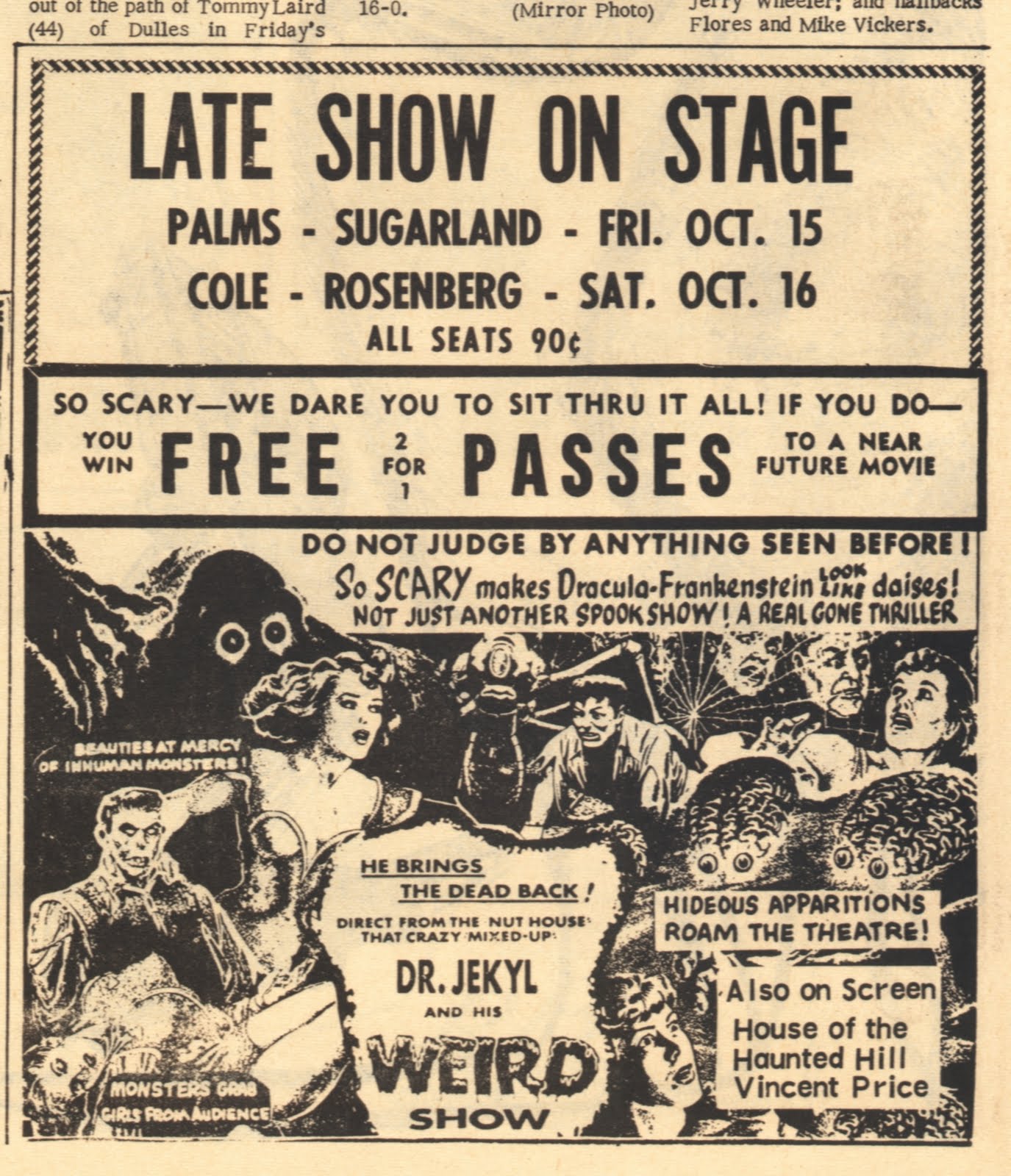
        Here are a couple of old movie ads.  The first comes from The Fort Bend Mirror published on October 14, 1965.  The 2nd is a lobby card/schedule for December, 1954.  I'll bet "Killer Leopard" with Johnny Sheffield was a big hit with Sugar Land's cineasts.


        Crown Cafe


        Here's an undated photo of the cafe that sat in the old commercial district in front of the refinery.  The sign calls it the 'R & R Cafe.'  I knew it as 'The Crown Cafe' or 'The Red Barn Cafe.'

        I believe it was called the latter when Bill 'Sweet Pea' Gandy ran it in the '60s.  I remember hearing his wife Dorothy talk about making pies for the cafe.  She said she got up every morning and made pies.  She got to the point she was sick of pies - couldn't stand thinking about them.

        I'm certain it was called 'The Crown Cafe' for many years prior to the Gandys' proprietorship.  Andy Anderson operated it under that name, but I can't recall exactly when that was.


        Sugar Land's House Of Pain


        I found this picture of the old Sugar Land clinic.  I don't know exactly when it opened, but it must have been sometime in the late 1940s. It sat on the northeast corner of Highway-90A & Ulrich Street. Before it opened Sugar Land's doctors had a small 'clinic' in the old drug store that sat next to the administrative office of Imperial Sugar Company in front of the refinery.  Here's a photo of the 'new' clinic.


        Here's a photo of the 'old' clinic (drug store).

        Laura Eldridge Hospital (Continued)


        I went through Bettye & Leon Anhaiser's archive of photos (many thanks to them) and found additional photos of the 'new' Laura Eldridge Memorial Hospital which opened in 1957 on Eldridge Road.  I determined the date from Bob Armstrong's book on Sugar Land.  I also learned that I'd got Mrs. Eldridge's name wrong.  I thought it was 'Laurel" instead of "Laura." The photo below appears to show the hospital soon after it opened.


        I think this next photo shows Mr. I. H. Kempner, Sr. speaking at the opening.  I can't identify any of the other men.


        This final picture shows hospital administrator, Bill Chadwick, Esther Kirkpatrick, & Leon Anhaiser.  I don't know the details, but I think the Sugar Land Lions Club was donating new wheel chairs to the hospital.  Leon was President of the Lions Club at one time.  Mrs. Kirkpatrick was a member of the hospital board, I think.  The date must be around 1966 or '67.


        I remember my first visit to the hospital.  It must have happened soon after it opened.  My family went to a Sugar Land High School football game in the fall of 1957.  I'm almost certain it was the first game of the season in East Bernard.  

        I began running a fever during the game.  I also had chills, which caused my mother to make ominous suggestions -- nothing dramatic, but not the kind of thing I wanted to hear.  She told my dad they should stop by the hospital on the way home, so one of the doctors could take a look at me.  (Residents went to the hospital for after-hours treatment when the clinic was closed.)  

        Although I was feeling pretty puny, I certainly didn't want to see a doctor, but my opinion didn't count since I was just 7-years old.  I'm not sure which doctor was on duty, but one of them said the dreaded words, "He's fine, but we'll give him a penicillen shot just to make sure."  For ever after I've never had a good feeling about hospitals.

        Friday, August 12, 2011

        Laura Eldridge Hospital


        Facebook has a group called "You Know You're From Sugar Land If ..." There's been quite a lot of discussion about several topics, but one is the original Laura Eldridge Hospital which opened in 1923 and was located at the northeast corner of Wood & Lakeview Streets. You're a certified Sugar Lander if you were born in that hospital. (I wasn't.)

        I've heard Betty Jenkins tell a story about a newcomer who claimed old Sugar Land didn't have a hospital. She replied, "IT DID have a hospital. I know because I worked in it." The first 3 photos below show the original hospital. The last photo shows the 'new' Laura Eldridge Hospital which opened its doors in 1957 at the intersection of Eldridge Road & Lakeview (the northeast corner). It is now a recreational annex for The First United Methodist Church.


        More Faces to Sugar Land Street & School Names


        Here are a few more photos of people for whom Sugar Land streets and schools are named. (Click here to view the City's info page on Sugar Land street names.)

        Cordes Drive

        Roy Cordes, Sr. was a Sugar Land councilman and served as mayor from 1973 to 1981. Roy Cordes, Jr. is Fort Bend County's attorney.


        Drabek Elementary School

        Rita Drabek was a long-time teacher and school board member for Fort Bend ISD.


        Kempner Stadium

        I. H. 'Herbert' Kempner, Jr. was president of Imperial Sugar Company 1945 - 1953.


        Harman Drive/Bridge

        T. E. Harman was Sugar Land's first mayor from 1959 to 1961. He served as mayor again from 1965 to 1967.


        Rozelle Avenue

        T. C. Rozelle, Jr. was the long-time personnel manager at Imperial Sugar Company and served as Sugar Land city councilman from 1961 to 1981.


        Ice House & 7-11 Construction


        Another hot topic in the Facebook group, "You Know You're From Sugar Land If ...", is the old 7-11 which was located on Highway-90A on the west side of town (approximately where the Texaco station now sits). The photo below shows the convenience store that preceded the 7-11. Residents called it "The Ice House," or "Preston's". If you look closely on the left, you can see construction forms for the 7-11's foundation. I think it opened in 1956.


        Early View of Sugar Land's South Side


        I don't have a date for this photo, but it must be from the 1940s. It shows Guether Street (on the left bank of Oyster Creek) before any of Brookside was developed. If Venice Street exists, it's just a dirt track into the cotton field where the subdivision now sits.


        Saturday, August 6, 2011

        More Sugar Land School & Street Names


        Here are a few more faces for Sugar Land school & street names. (Click here to view the City's info page on street names.)


        Hightower High School

        L. V. 'Dugan' Hightower, coach, teacher, & principal in Sugar Land ISD & Fort Bend ISD


        Guenther Street

        E. O. Guenther, Cashier of Imperial Bank & Trust and chief credit officer of Sugarland Industries (1908 - 1950s)


        Mercer Stadium

        Edward Mercer, Superintendent Sugar Land ISD & administrator Fort Bend ISD


        Gloria Court


        Gloria Ross Hall, Sugar Land High School graduate (Class of '52), married to Kenneth Hall, & City secretary in the 1970’s


        Matlage Way


        W. T. Matlage, Sr., long-time pharmacist & manager of Sugar Land's drug store (1908 - 1950s)


        Central Unit In Sugar Land Is Closing


        Some of you may have seen this on KHOU (Channel 11 here in Houston) recently. Others may have seen it on Facebook. Here's the short news clip about the State Prison System closing down the Central Unit west of Sugar Land. The City will open it for development soon.

        Link to news clip.

        Several years ago, I had the chance to hear some women who'd lived in Sugar Land for many years reminisce about old times. Here are two stories relevant to the prison farm west of town.

        Maxene Gary: "You know, we never locked our doors. We left keys in our cars. We weren't concerned about security. But whenever a prisoner got loose, people went on alert.

        "One time Beth and Leroy Mills, who lived on Main Street, had a prisoner hide under their house. She took Leroy to work, and this one got into the house and helped himself to some of Leroy's clothes ... I guess the prisoner swam the creek to get in their yard. Anyway, he put on those clothes while they were gone, and when she got back he was under the house. Somehow he got away and hopped a bus to Houston, where they finally caught him. That incident always stuck in my mind because we never locked our doors."

        Dot Harrington: "We always knew when there was a prisoner loose because they'd blow the fire whistle. Of course, they blew the fire whistle for fires, but they also blew the whistle whenever there was an escapee."


        Betty Jenkins: "I remember one time Leslie and Maxine Wheeler and another couple went to a Rice football game. They went to Charlie White's restaurant before the game. Dr. Wheeler left his car in the parking lot with the keys in it - I guess he thought it was safe.

        "Well, they walked across Main Street to the stadium. When they came back after the game their car was missing. A convict who'd escaped in Sugar Land stole their car. You talk about a coincidence!"

        J. B. Fowler's Memories of Sugar Land Circa 1918


        Here's an article I found in T. C. Rozelle's archive. It's undated, but I think it appeared in The Houston Post sometime in 1952. Notice Mr. Fowler's comment that the refinery provided power to the town in the WWI era. I'd like to find out when HL&P began service in Sugar Land. I think it must have been in the 1920s.


        The City of Sugar Land, 50 Years Ago


        I think this article came from The Fort Bend Mirror, but I could be wrong. I found it in T. C. Rozelle's archive. Sugar Land has come a long way in 50 years.

        Remember to click on the image to magnify it.


        Mystery Photo


        Can anyone identify the two little indians with the indian chief? I thought this was a great photo. Dulles alums in the Class of '60 & '68 may have the best chance at making a correct guess.

        Sunday, July 31, 2011

        Sugar Land Street & School Names


        I thought I'd post pictures of people after whom well-known streets & schools are named. The City of Sugar Land Web site has a page on street names. Click here.

        Eldridge Road

        William T. Eldridge, Sr., General Manager of Imperial Sugar Company from 1908 -1932 (photo taken c. 1925)


        Jess Pirtle Boulevard

        Jess Pirtle, engineer & surveyor for Sugarland Industries & founding alderman of the City of Sugar Land in 1959 (photo taken with son Rennie c. 1924)


        Ulrich Street

        Gus Ulrich, General Manager of Sugarland Industries 1919-1947 (photo taken in mid-1940s )


        Marcario Garcia Middle School

        Marcario Garcia, Medal of Honor Winner WWII (photo taken with President Truman in 1945)


        M. R. Wood Alternative Education Center School

        M. R. Wood, Plant Superintendent of Imperial Sugar Refinery (photo date unknown)


        Brooks Street

        Captain William McCan Brooks, chief of tennant farming, Sugarland Industries 1914-1932 (photo date unknown)

        M. R. Wood's Brochure, "How Sugar Is Made"


        I found this brochure in T. C. Rozelle's archive. It's not dated, but Imperial must have produced it in the 1920s. It's not short, but if you're interested in the basic steps in sugar refining, you'll want to skim it. I don't think the general scheme changed all that much over the years, even though technical improvements were incorporated in the refinery.

        Leon Anhaiser identified the granulators in a picture I posted a few weeks ago. Wood mentions them in the brochure. I wouldn't doubt they are the same ones operating at the time he wrote it.

        An interesting point about Mr. Wood - I've seen him mentioned as the chief engineer at Imperial, but he must have been head of the lab/chemistry department. too. He seems to have been a jack-of-all-trades. Kempner and Eldridge appear to have relied on him quite a bit.


        Dulles Class of 1961 - 50th Reunion


        My thanks to BJ Binford Pitts for sending me this video album of her class's 50th Anniversary Reunion out at her brother Red's place in Fairchilds. I had a great time, but I'm sorry I missed the Code Blue, Miss Hanging Baskets & Mr. Stud Muffin contests! Next time I won't be late for the party.

        Link to video album.