Drop Down MenusCSS Drop Down MenuPure CSS Dropdown Menu

Saturday, October 24, 2015

News & Updates

 
I enjoy doing this blog with one exception: relaying bad news.  I'm sorry to report that Lupe Rodriguez (DHS '63) died recently.  Click here to view an obituary. (Thank you, Roger Howard, for passing along the information.)
 
Lupe Rodriguez as an employee of Imperial Sugar Company in the mid 1960s.

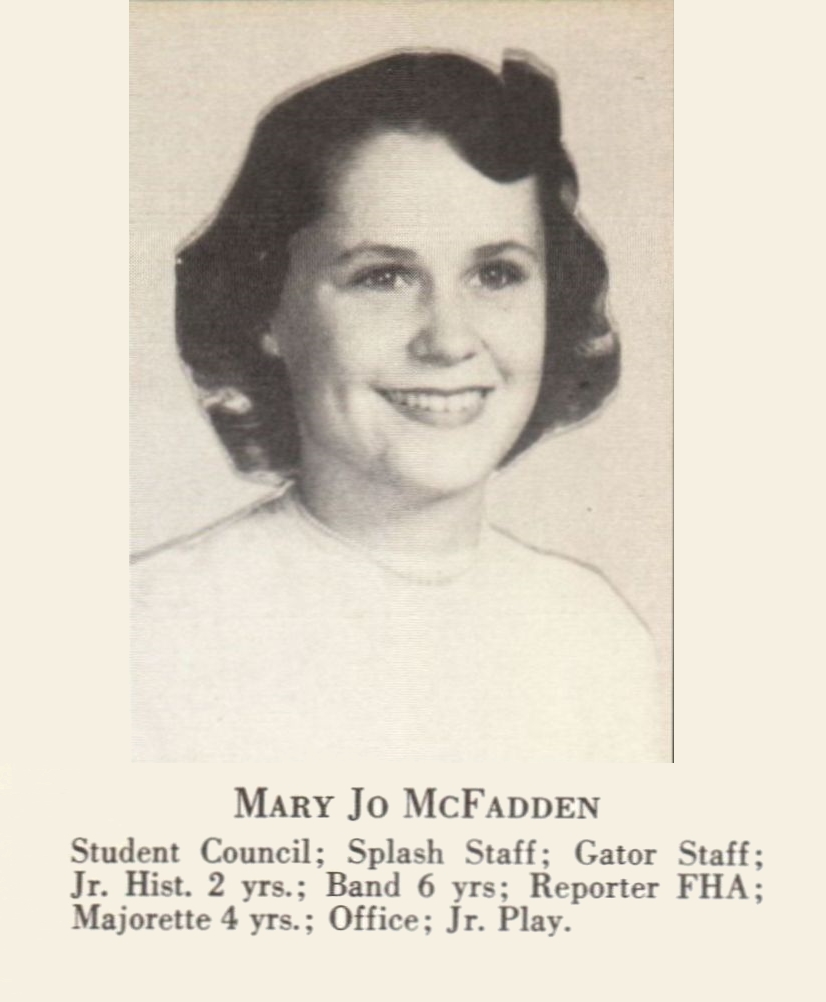
I received news from Pam Helmcamp Clark (DHS '60), saying Mary Jo McFadden George (SLHS '51) also passed away recently.  Click here to view an obituary.
 
 
I'm also saddened to report the death of Patrick Gustin, Cindy and Mike's younger son.  He died in an auto accident in Florida.  Click here to view an obituary

I understand that losing a child is one of the hardest setbacks in life although losing a parent, sibling or spouse isn't easy either.  I hope the Gustin, George, and Rodriguez families are overcoming the loss of their loved ones.
  
A recent photo of Cindy Buehring Gustin and her mother.

On a brighter note, the Sugar Land Heritage Foundation has a fundraiser coming up in a week or so.  Here's the info -- leave your hip flask at home.
 
What's the pass word?


I nearly forgot a couple of things.  First, I want to thank Tommy Laird and Randy Edwards (both DHS '67) for identifying Billie and Bill Louviere, Jr. in the following photo taken at the Mt. Pleasant Baptist Church in 1955.  They are sitting on the left side of the front pew in the background.


I also want to thank Donna Christopher Baker (DHS '63) for reminding me that her father's first name was Marshall.  Many locals and former employees of Imperial will remember him as Marshall Christopher.  He's the man on the left in this photo.

Missouri City High School


Thank you, Lee Elkins LeGrand (DHS '71), for letting me scan these photos from the Elkins family scrapbook.  Many of you know her father was Lawrence Elkins (MCHS '42), who worked for MCISD and Fort Bend ISD for many years.  In fact, Elkins High School is named after him.

The first photo shows the 1941 Mustang Band on the steps of the old auditorium, which I'm happy to say is still standing. 

The next photo shows the 1939-40 championship boys basketball team.  (I'm not sure what championship they won.  Most likely their Class A bi-district title - maybe higher titles, too.)  I've included the annotations on the back.  I recognized Mr. Elkins and Mr. Jerry Segers, Sr. right away.  I didn't realize the coach was Mr. E. O. Jones, Dulles High School's first principle.

The last photo shows the 1950 boys basketball team, which also won an unidentified championship.  I recognized Coach Bobby Williams (#21) right away.  As you can see, Mr. Elkins is their coach.  I don't recognize anyone else.  Any help with ids?


Analysis of Old Aerial Photo


The March 1957 issue of The Imperial Crown, Imperial Sugar Company's employee bulletin, included the following photo and asked its readers to guess the date it was taken.


I've clipped the answers from April's issue.  I thought this article was a good exercise in showing how the dates of old photos are determined if they are unknown.


I've annotated the photo to help identify the landmarks used to determine the date.


More People of Old Sugar Land


If I have posted the next 4 photos before, they are worth repeating because they show the citizens of Sugar Land getting their picture taken.  (The photos are sections of a very large panoramic print.  It would be impossible to show the unsegmented photo on this blog.)

'Photo Day' was probably a very rare event at the time.  I've looked as closely as possible, and I can't confirm there are any cars in the shot, so my guess is this photo was taken well before WWI.
 
Far left quarter of the panorama showing the 1903 train depot.

Left-middle quarter showing stores, cafe, barber/beauty shop and part of the General Mercantile Store.

Right-middle quarter showing the General Mercantile Store, Drug Store and Imperial Offices with the refinery in the background.

Far right quarter showing the Imperial Offices and more of the refinery.  (The camera appears to be located at the intersection of Brooks St. and Highway 90A.

I've forgotten who posted this photo on Facebook, but my thanks go to the anonymous sharer.  It shows a selection of Dulles High's Class of '73 when they were 4th graders at Sugar Land Elementary.
 

Joan Maresh Hansen (DHS '68) sent me the next photo.  Someone found it in a closet at Dulles High School recently, and wondered who the girls were.  I can't identify the younger girl, but the other is Debbie Duggan Gamble (DHS '69).
 
 
The following photo shows Frances Koon Tise (SLHS '48) posing on a concrete bridge on Oil Field Road.  I think this photo must date from around 1948.
 

The next photo shows children swimming in the pool at the Humble Camp, which was located on Oil Field Road just north of the levee.  I think the photo dates from around 1940.  That may be my mother in the pool with her feet sticking out of the water.  I think that's my aunt (Mayme Rachuig Haus, SLHS '48) behind the boy and girl on the right of the group.
 

And last but not least, we have Pam Bartolo Moody (DHS '71) riding a bronco at Kiddie Wonder Land on South Main.  Note the boots.  (Thanks, Pam.)
 

Hurricane Carla Revisited


I missed the 54th anniversary of Hurricane Carla last month, but I'll post this entry anyway.  I've posted a few items in the past about Carla's effects on Sugar Land.


Many local families took shelter in the refinery.  It was a safe haven for those who didn't want to weather the storm in their homes.  A couple of older buildings in the refinery complex suffered some damage, however. 


Here are a few additional items I found when researching Carla a couple of months ago.


Monday, August 24, 2015

News & Updates


I've finally got the correct photo from the 1949 Sugar Land Gator yearbook showing Jane Broughton Schiller's 6th grade class.


I mentioned to Dulles alums that Rit Jons passed away in Kerrville last month.  Click here to view an obituary.  My best to Becky and their children and grandchildren.

Also, Scotty Hightower Bass (DHS '66) sent me this note about the 1916 Cleveland Hustlers baseball team on which her grandfather, L. V. Hightower, Sr. played.

We have really enjoyed this picture and article on my grandfather, Lockhart Valentine Sr. # 6 on the Hustler baseball team of Cleveland. Also in the picture are his brothers,  Sam Hightower and Cam Hightower. I am trying  to get more information on the game. It appears that this picture was taken a year or two before Daddy was born in 1917. What wonderful history to pass on to our children and grandchildren!!!  Daddy's father was a fabulous baseball player and I think he played on the Houston Buffalos  team before becoming Sheriff of Liberty and then County Clerk. When he passed away in 1946, a year before I was born, my grandmother Margaret Scott Hightower "Maggie" took over as County Clerk. My Uncle Ross Hightower played baseball for Baylor, but Dad and his brother Don were the football players from Texas A&I.

More Images of Old Sugar Land


Story Sloane posted the following photo (without restrictions) on Facebook recently, and I thought it gave a spectacular view down Oyster Creek.  I don't have a firm date, but my guess is roughly 1950.
 
(Story Sloane Collection)
 
I've magnified the Belknap area, which shows the sparse development of that section of town.
 
(Story Sloane Collection)
This magnification shows the area that's now Sugar Lakes and the Fluor complex.  Of course, the norther edge of what's become First Colony is in the deep background.
 
(Story Sloane Collection)
 
When I researched the stereoscopic photo I posted a few weeks ago, I examined the next two images.  I'm not sure if I've posted them before, but I thought I'd post them now with comparisons of what the locations look like today.  I think these are very early photos showing the Cunningham Refinery before Kempner and Eldridge took over the plant in 1908.
 
(Click here for modern view.)

(Click here for modern view.)

This last photo shows old Imperial Boulevard as it looked just a few years after the two photos shown above.  I've included a modern view.
 
(Click here for modern view.)

More People of Old Sugar Land


Congratulations to Dulles High's Class of '65, who celebrated their 50th anniversary last weekend.  I wonder if they remembered the words to the school song without cheat sheets?


Dulles Class of '65 at their 50th anniversary.

I want to thank JoAnn Cangelosi Hargrove (DHS '65) for scanning and sending me the following two photos of her parents.  In late November or early December of 1951, her parents set up a promotional display for their Stafford hardware store in the lobby of The Palms Theater.  As you can see from the sign, they gave away a new refrigerator as part of the promotion.
  
 Doris Durdin, County Extension Agent on the left with Carmaline Cangelosi in the lobby of The Palms Theater, 1951. (Photo courtesy of JoAnn Cangelosi Hargrove)
  
 Carmaline and Pete Cangelosi, Sr. in the lobby of The Palms Theater, 1951. (Photo Courtesy of JoAnn Cangelosi Hargrove)

I'm going to make a wild guess, but I think the last picture shows the east side of the lobby.  The refreshment stand is out of view on the right.  The hallway behind the Cangelosis leads to an entrance ramp into the auditorium.  On the left side of the hallway, just opposite the ramp, is the door to the men's restroom.  The women's powder room is on the left of the photo.
Thank you JoAnn! 

The next photo is undated, but it comes from the early 20th century.  It shows a Packing Department worker filling a barrel of sugar, when barrels were still a major mode of packaging.
 
 
The following photo shows the dedication service of Mt. Pleasant Baptist Church, Mayfield Park, in 1955.  Eunice Thomas is pinning a corsage on Mrs. W. H. Louviere, Sr.  Heywood Davis and Bertha Davis are on the left. W. H. Louviere, Sr. is seated to the right of his wife, but I can't identify anyone else.
  
  
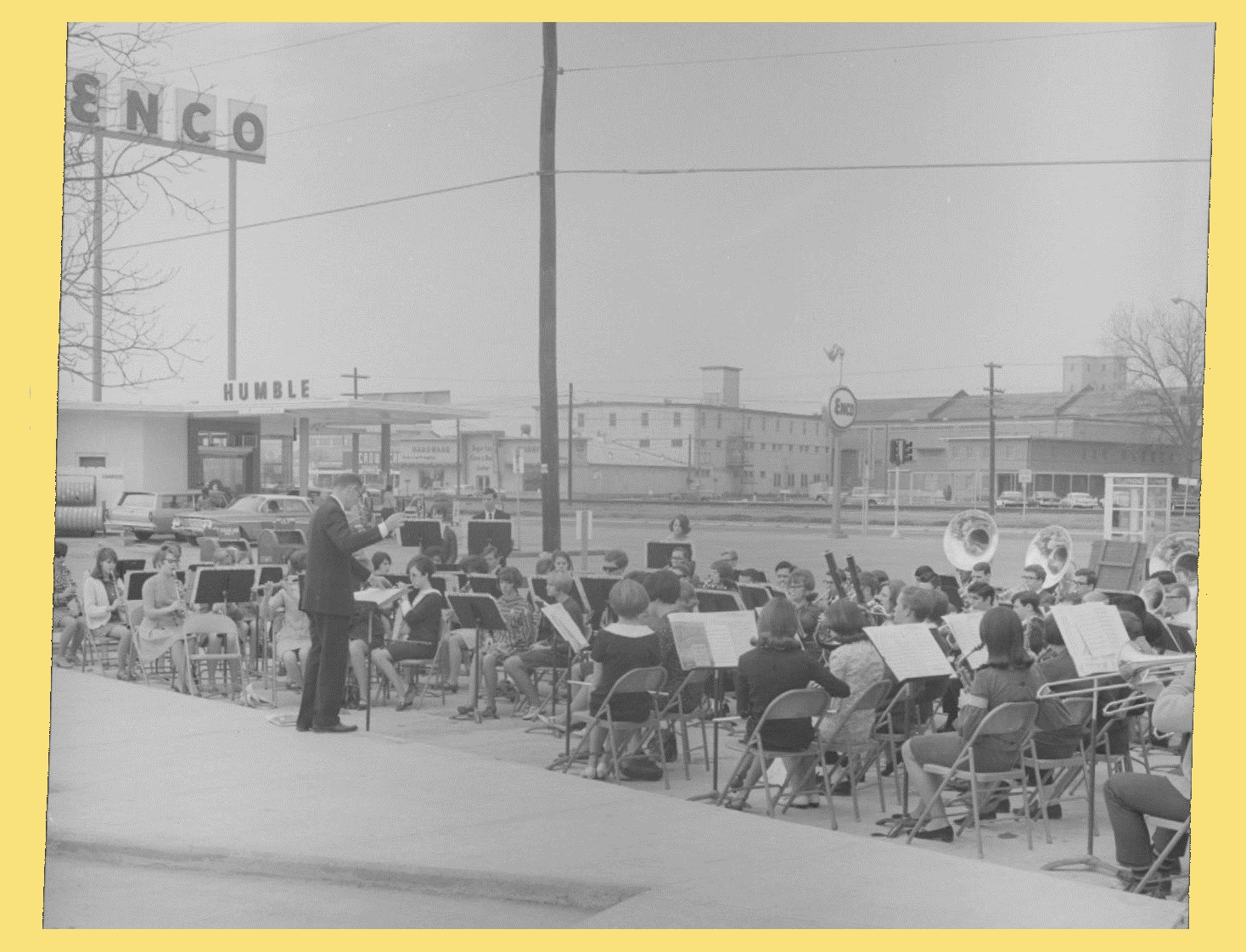
The next photo shows the Dulles High School band, led by Director Jim Gary, at the opening of the Sugar Land Post Office on Brooks Street in the Spring of 1967.  I recognize lots of knuckleheads in this picture, including myself.


Traces of Texas posted the following photo on Facebook recently.  It's in the Sugar Land Heritage Foundation collection.  We have a second photo taken in the same 'shoot,' which you see below.


I'm not absolutely certain, but I think two of these young women are sisters Alice and Rhoma Phipps.  Alice married Bob Storm and Rhoma married William Aven.  I don't have any clues on the other two, or when and where the photo was taken.  I know Rhoma was born in 1898, so I'll guess 1914 to 1916.

Picking Cotton


I've had a recent email conversation with a couple of my college buddies about cotton.  One of them is from Crosbyton, Texas where his family ran a cotton farm.  I've learned quite a bit about raising and processing cotton.  In fact, there's too much to put in one post, so I'll chop the topic into 4 posts.

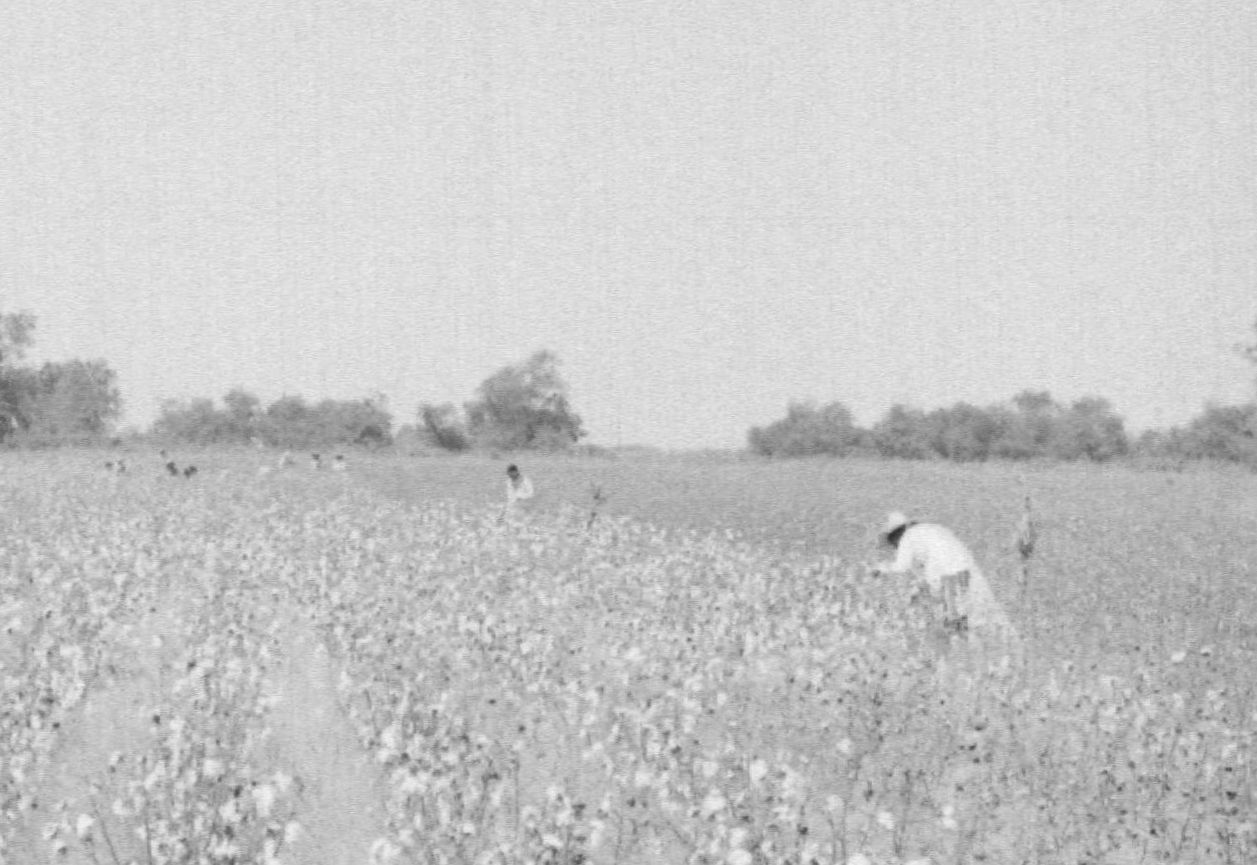
I'll start with picking because it often begins at this time of year.  Just a couple of photos showing field laborers at work will indicate the back-breaking nature of picking cotton by hand.

Undated photo of cotton field where Hall Lake is now located.

 Probably the same field during a harvest in the late 1950s.  (Note the laborers picking by hand.)
 
A magnification of the laborers.
 
Pickers dragged a large bag along the ground as they filled it with cotton.  Summer heat wasn't the only difficulty.  An adult (as you can see in the photo) had to bend over to reach the plants.  Eventually, tired backs forced pickers to work from a kneeling position.  They often wore knee pads to save wear and tear on overalls and sore knees.  

I guess children had an advantage in not having to bend over to reach the plants.  This photo shows students at a small school near Corsicana in 1913.  Each of them picked cotton before entering school that fall.  (Child labor was common in the cotton fields before mechanization.)
 
(Traces of Texas)

My friend up in the South Plains said picking cotton down here is different than it is up there.  Conditions up there meant hand-picking required pulling the burr from the plant.  (The burr is the dried shell from which the boll emerges.)  Down here the conditions (and maybe the hybrids we can grow) allowed pickers to pull the lint from the plant without taking the burr.  The lint still contained the seed, but it was far cleaner than cotton picked in north Texas.  This difference still applies to mechanical harvesting used today.

Of course, mechanized harvesting became common in the 1960s.  The next photo shows an early picker used in the same field south of old Sugar Land.  It looks like the machine is mounted on a tractor, although it's probably a permanent attachment.
 Rear view of an early mechanized cotton picker in field near Sugar Land.
  
  View of early mechanized cotton picker in field near Sugar Land.
 
Magnified view of early mechanized cotton picker in field near Sugar Land.
 
Technological advancements have continued to the present day. Click here to view a modern cotton picker.

Next time a short discussion of hauling cotton.

Highway 90A Completed in Sugar Land, 1927


I mentioned in the last batch of posts that this year marks the 100th anniversary of the Old Spanish Trail, known as Highway 90A here in Sugar Land.  Further research has turned up more information, but not as much as I'd hoped.  

I need to locate issues of the Texas Commercial News published in Sugar Land to get the local view of the highway program, but here is what I've learned from other resources.

A Houston Post article published in July 1919  said the exact route of the OST hadn't been determined, but it would likely follow the Southern Pacific rail line.  I read in another source that the railroad was critical to the project due to its right-of-way and its role in delivering men and materiel to construction sites.

In October 1919 the Old Spanish Trail Association received a charter from the State of Texas and had started local organizations in most of the counties in the states through which the highway would pass.  Since the State of Texas encompassed (by a wide margin) the largest segment of the 2,800-mile highway, and since San Antonio was the approximate mid-point, San Antonio was selected as the OST Association's headquarters.  Their offices were located in the Gunter Hotel.

Despite all this activity there was little real improvement completed in 1919 on the local roads that became the OST.

1921 newspaper article highlights road problems.
 
Naturally, the Texas Highway Department (THD) played a major role in this program.  THD was the precursor to today's TXDOT.  It was created in 1917 to take advantage of the 1916 Federal Road Aid Act, which granted funds to states that centralized control, construction, and maintenance of their roads.

 Road paving in Sugar Land, 1927.
 
Road paving near Sugar Creek Boulevard, 1927.

In 1925 THD relieved counties of road maintenance.  Counties were still obligated to obtain rights-of-way for new roads, however.

 Cars waiting just east of Eldridge Road to pass through Sugar Land after opening ceremony, 1927.
 
  Cars & passengers waiting just east of Eldridge Road to pass through Sugar Land after opening ceremony, 1927.
 
In 1925 State Attorney General Dan Moody charged Governor Ma Ferguson's administration with corruption and malfeasance in its handling of road contracts.  Moody won his case and became the next governor, although Ma Ferguson returned to office in the 1930s.
 
Paving in the center of Sugar Land, 1927.

As you can see from these photos, many of which I've posted before, 1927 was a big year for Sugar Land's main highway.  Highway 90A was paved as a two-lane road through town and across Fort Bend County.  In 1947 two additional lanes (handling east bound traffic) were completed.  So it goes. 

 W. T. Eldridge, Sr. in passenger seat of lead car (a Rolls-Royce), 1927.
 
I. H. Kempner, Sr., W. T. Eldridge, Sr. and other dignitaries at ribbon cutting, 1927.