Drop Down MenusCSS Drop Down MenuPure CSS Dropdown Menu

Wednesday, December 23, 2015

People of Imperial Sugar


The Lab


The Heitman brothers in 1961.

Bacteriologist Hugh Lynn at work in 1961.

Wayne Boehm checking samples in 1962.

Lillian Urban Grohman in 1964.

Unidentified men working in the lab.

Personnel Office


M. R. Wood School students touring the refinery in 1959.


Prairie View A&M students touring the refinery in 1959.

Ken Hall leading a tour group through the new Melt House in 1959.

W. H. Louiviere, Sr., Hugh Lynn, W. O. Caraway, and George Andre on a tour of the new Melt House in 1959.

Public visitors touring the new Melt House in 1959.


Tommie Green in 1963.

Betty Sue Douglas Lubajosky in 1967.

Mrs. Audrey Cooper, Mrs. Pat Jarrell, and Mrs. Gloria Krehmeier in 1969.

Betty Sue Douglas Lubajosky showing an Imperial gift box in the late 1960s.


Summer Hires

Matthew Hall, Daniel Stavinoha, Alec Horn, and Wayne Mayhood in the summer of 1968.

Cathy Louviere in the late 1960s.

Unidentified, Eddie Mendoza, Bill Coker, G. W. Melton, Ronnie Rivera, and unidentifed in the early 1970s.

Alfred Smallwood in the late 1960s.

Mitchell Hall in 1968.


Donnie Sampson in early 1960s.

Charles Ray Foy in the early 1960s.

Leon Anhaiser in the late 1950s.

Bobby Borowski in the late 1950s.

Old Refinery Photos


The following selection of images show the Sugar Land refinery in its earliest stages.  I think it's very possible the first photo shows the Cunningham refinery before Kempner and Eldridge took it over in 1908.  I don't think I've posted it before, although I'm reasonably certain I've posted the other three.  

The first photo is sort of a mystery.  I think we'll need the other photos to analyze it.  The caption says it's an east view of the refinery.  My guess is that the camera is located roughly where Ulrich St. intersects Guyer St.  Here's a Google Street View of the location.


I wonder why no houses appear in the left foreground of the image.  I know aerial photos from the 1920s show houses close to the north boundary of the refinery, but they are missing in this early photo, or maybe they're out of view on the left.  (Just to clear up any confusion: that water tower is not the one now located next to the Main St. Bridge.  Several water towers of various heights have served Sugar Land over its history.)
 

A westward view of the refinery from the east bank of Oyster Creek, near the intersection of Main & Kempner Streets. (The date is probably post-1908.)

A northeast view of the refinery from near the intersection of Kempner & Ulrich Streets. (The date is sometime around 1900.)

Another westward view of the refinery from the east bank of Oyster Creek, taken a little later than the second photo above.

We'll review these photos to determine the date and camera location in the first one.  We learn it's another early photo of the first refinery in Sugar Land.

An Old Timer Visits Sugar Land in 1920

 
I've mentioned several times before that Sugar Land had a local paper from June 1917 to sometime in the early 1930s.  It name changed at least once (I think), but its early name was the Texas Farm and Industrial News.

Jane McMeans has donated a microfilm reel of copies printed from June 1917 to May 1920.  It's not a complete set, and one of my goals is to collect as many issues as possible.  Based on what I've seen so far, they are an invaluable record of the town's history.

Anyway, I found the brief article below in an issue printed in 1920.  It recounts the reminiscences of R. Y. Secrest on a return visit to Sugar Land after a 42-year absence.

As you can see, it's very difficult to read.  I've included a transcript below, although there were a few words I couldn't make out. I made a few corrections to clarify the text.

Note that Walker Station, called Sartartia Station in 1920, was the main shipping point in the area back in the 1870s.  Secrest remembered the Terry-Kyle sugar mill and the layout of the town.  (Actually, it probably wasn't even a town at that time.)  Also notice his description of how they made sugar before the days of modern refining.  (N.B.: A hogshead is a large wooden barrel.)
 

Afer 42 Years He Visits Sugar Land

R.Y. Secrest Finds Contrasts
Here Since He Went Away

Remembers When Walker Station Was
the Post Office and Finds One of
His Playmates Still Here


Back in the days when the station now called Sartartia was called Walker Station, and when the Sugar Land of the present shipped through Walker Station by means of a spur track connection, R. Y. Secrest left this vicinity.  That was forty-two years ago.  We hear he came back to Sugar Land for the first time since then.  He was welcomed by T. J. Hodge, (?) Oyster Creek veteran who for (74?) years has dwelt in this vicinity since he was born. Mr. Secrest is (?) years younger than Mr. Hodge.  They played together (?) boys (?) the long ago. The visitor hoped to find Mrs. Betty Shamblin and Mrs. Emma McLaughlin with whom he used to go to parties, when they were the Misses Fields, daughters of W. D. Fields.  They now live at distances too remote for Mr. Secrest to make during his few hours here.

Mr. Secrest paid his respects to Miss Vera Teague of the Imperial Bank and Trust Company whose family he has known for many years at Georgetown and whose cousin married his son, P. G. Secrest, a jeweler at Bay City.

Mr. Secrest recalled many events of long ago in this vicinity.  His father, Felix G. Secrest, was the first agent for the Southern Pacific Railroad here.  He succeeded his father and administered the affairs of Walker Station for seven years, "allotting' cars to Sugar Land, which then used as many as three or four each week.  There was a brick sugar house here owned by R. G. Kyle and B. F. Terry, the latter for more than 50 years famous as the commander of Terry's Texas Rangers.  The post office was then at Walker Station.

Plantation sugars were made by a system of open kettles or vats.  After the sugar had been placed in hogheads, these were set on poles above the vats and permitted to "leak," the "leakings" again going through the sugar making process.  In those days W. P. Quigg had just purchased what is now the Harlem farm from a Mr. McMann.  The Thatcher, Borden and Brevard places down Oyster Creek were land marks of the times.  Killing deer was easy, and there was plenty of small game and lots of good fishing.

At Sugar Land the negro quarters extended down what is now the shaded avenue of Eldridge Park.  These, the sugar house and the foreman's residence, which stood near the railroad track, made up the Sugar Land buildings of these times.

Mr. Secrest married Miss Hettie Dunlavy on October 9, 1873, and their six children all reside in Texas, all the way from the Red River eastern (boundary) to the Rio Grand western boundary.

Sunday, December 6, 2015

News & Updates


I regret having to report the deaths of three people with ties to old Sugar Land.  The first is Linda Vaccaro King, who grew up in Stafford, attended Dulles High School, and lived in Sugar Land.
 

The second person is my Dulles classmate (DHS '68) Fred Juroska.  I think Fred lived all his life in Stafford, but I could be wrong about that. 
 

The last person is Mr. Louis Mutina, Sr., a long-time resident of The Hill and retired Imperial employee.  Here is an obituary.  

My sincerest condolence go to Jo Vaccaro (DHS '68) and Linda's extended family, Theresa Juroska (Fred's daughter) and the extended Juroska family, and Louis, Jr., David, and all the other members of the Mutina family.

One last item from Kristin Lytle to end this news on a happier note: 
 
Annual Christmas Decorating Contest for Holidays in The Hill will be December 11th. Judging will take place between 6:00-7:00 p.m. Justice of the Peace, Justin Joyce and Sugar Land City Council at Large candidate, Mary Joyce will be judging this year. Best of Show will receive a $100 gift card and the 2015 Sugar Land Heritage Foundation ornament, 1st and 2nd Place will both receive a $50 gift card and this year's Heritage ornament. Deck the halls y'all!!!

Imperial Sugar Company Photos

 
A 1987 aerial of Imperial Sugar's automated raw sugar dock in Galveston.

An undated, color aerial photo of Imperial Sugar's automated raw sugar dock in Galveston.

An undated photo showing laborers loading raw sugar in a rail car at the old dock in Galveston.

An undated photo of the Melt House in the Imperial refinery in Sugar Land.

An undated photo of a pan house in the Imperial refinery in Sugar Land.  (This is the step at which liquid sugar is crystallized into table sugar.)

An undated photo the Packing Department Imperial's refinery in Sugar Land.

An undated photo of a refined sugar warehouse in the Imperial refinery in Sugar Land.

Another undated photo of a refined sugar warehouse in the Imperial refinery in Sugar Land.

An undated photo of the raw sugar warehouse in the Imperial refinery in Sugar Land.

Maxine Wheeler showcasing Imperial Sugar at the old Sugar Land grocery store.

A black & white version of early Imperial advertising artwork.

An undated photo of the Imperial refinery in Sugar Land.

Aerial Views of Sugar Land's Brazos River Corridor Parks

Until a few days ago, I thought these city parks along the Brazos River were new additions to Sugar Land's landscape, but after making the short video (see the following link), I learned that Sugar Land's Memorial Park opened in 2012 and Pawm Springs Dog Park opened in 2009.  I need to get out more often, but I hear Sugar Land's dogs think Pawm Springs Park is "the cat's meow."  The Smart Financial Centre (the performing arts complex under construction in the video) just celebrated its 'topping out ceremony' a few days ago.


Fort Bend County Historical Commission


The Friends of the Fort Bend County Historical Commission had a fundraiser in late November.  As Chairman of the Historical Commission, I want to thank everyone who made it a success and everyone who supported us with generous donations.

The Commission made a short video to show our benefactors a few of the things we've done with their donations.  We appreciate their support and want to put it to good use.  Click here to view the video.

More Missouri City High School Memorabilia


I want to thank Lee Elkins LeGrand (DHS '71) for letting me scan this copy of Missouri City High School's first yearbook.  It was called the Criterion and was issued in 1937.  As you'll see, the senior class made their yearbooks.  This copy is in very good shape.

I can understand why they took this approach.  After a few years of recovery, the Great Depression resumed with a vengeance in 1937.  I'm sure self-published annual was much more economical than contracting with a publishing company.  Sugar Land High School didn't publish an annual of any kind until 1947.

I will post more excerpts from this yearbook.


KPRC Transmitter Station

 
I received a note from a reader asking if I had any photos of the KPRC Radio's transmitting station which was located at the northeast corner of Eldridge Road and Highway 90A.  (Many old timers will recall Eldridge Road was called KPRC Road for many years.)

I'm happy to repost some of the photos I've shown before.


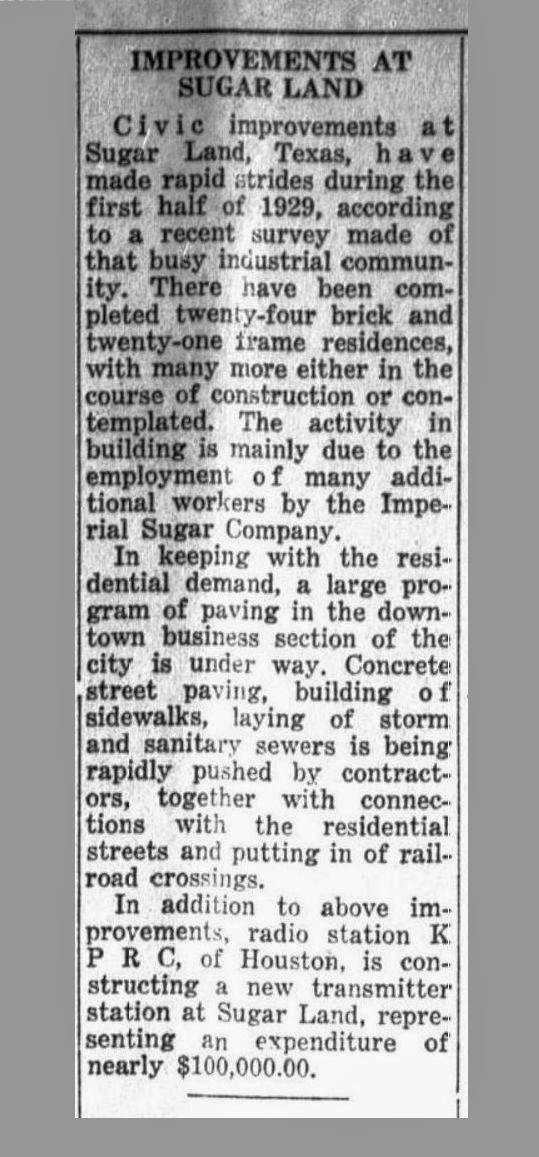
Here's a newspaper article I found at the Portal to Texas History.  The last paragraph mentions the construction of the station.  I know KPRC didn't operate the Sugar Land station for much more than a year before they moved to another one in La Porte.

         The Naples (Texas) Mirror, August 9, 1929 (The Portal to Texas History)

Miscellany


I recently received the following message from Roger Howard, a friend in the Class of '63 at Dulles High School.  I was unaware that Sugar Land's Main Street Bridge and Lonnie Green Park were geocache sites.  I was also unaware that Annette Williamson Wise (DHS '64) has a work in the Smithsonian.  Thanks, Roger.
 
Chuck,
  
I participate in a pastime called geocaching, basically a worldwide scavenger hunt using GPS devices to find hidden objects and record those finds. One such is a magnetic key holder located in Sugar Land on the metal bridge on Main Street. The reason I am passing along the info in the cache description (shown below in brackets) is the depiction of Annette Williamson's artistic endeavors for the City. Although this may be old news to you, it was information of which I was unaware.

[This cache is hidden on the foot bridge attached to the painted Main Street Bridge in Old Sugar Land. I've driven on this bridge countless times since I've lived in the Land of Sugar; however, I recently visited the attached foot bridge. The bridge is over the waterway from Cleveland Lake into Oyster Creek near the old Imperial Sugar Char House. I can't find much information on the Internet about this bridge that has a black & white pictorial history of Sugar Land. I found a little bit about the local artist: Annette Williamson Wise, who was a native Texan and passed-away in 2011. For our nation's Bicentennial Celebration in 1976 she designed Sugar Land's Commemorative Bicentennial Coin which can be found in The Smithsonian. The fire hydrants she painted in Old Sugar Land as a part of the celebration were featured in the July 1977 issue of Firehouse Magazine. Her fire hydrant painting of Benjamin Franklin was one of nine chosen across the nation to be published in a book about America's Bicentennial Celebration. Enjoy the view from the foot bridge, the photo op from the painted bridge, and the 1940s cottage-style homes in the neighborhood we fondly call “Old Sugar Land.” Lonnie Green Park is at the east end of First Street (at Wood Street) -- a small park along Oyster Creek (actually, Cleveland Lake) with a playground, park benches, picnic tables AND a geocache dedicated to the park's namesake.]

Roger

Here's a Google Street View of the bridge.
  
Roberta Cooke Prater is a graduate of Dulles High School (I'm not sure which year), and she's a long-time teacher at the school.  I can't recall the details, but she inherited Mr. Billie Wright's paddle, which is a cherished Viking relic.  Roberta posted a photo of it on Facebook, which appears below.  (Thank you, Roberta.)


I wonder who Sandra was.
  
I feel a little regret when looking at that paddle.  Mr. Wright never gave me any swats, so I'm not a member of the brotherhood.  One of my good friends and classmates rode Mr. Wright's bus, which went out toward Fresno and Arcola.  He said Mr. Wright had a routine he used on football players.  He'd give them a swat (we called them 'licks' back then) on game day to get 'em fired up for the game.  I'm sure that motivational tool is no longer in use.