Drop Down MenusCSS Drop Down MenuPure CSS Dropdown Menu
Showing posts with label Sugarland Industries. Show all posts

Thursday, May 31, 2018

John Pirtle's Oral History

John Pirtle was born in 1931 and graduated from Sugar Land High School in 1949. His family lived on "Rat Row" (old Imperial Blvd.), which is now covered by the expanded Nalco plant. Time has made sweeping changes to the town John grew up in, but his memories are still vivid and cherished. Read his interview to get a taste of Sugar Land back then.

Click the image below to read John Pirtle's account of his life in Sugar Land.
 

Thursday, June 22, 2017

More Images of Old Sugar Land


Click the image below to view a photo album of images of old Sugar Land.
   
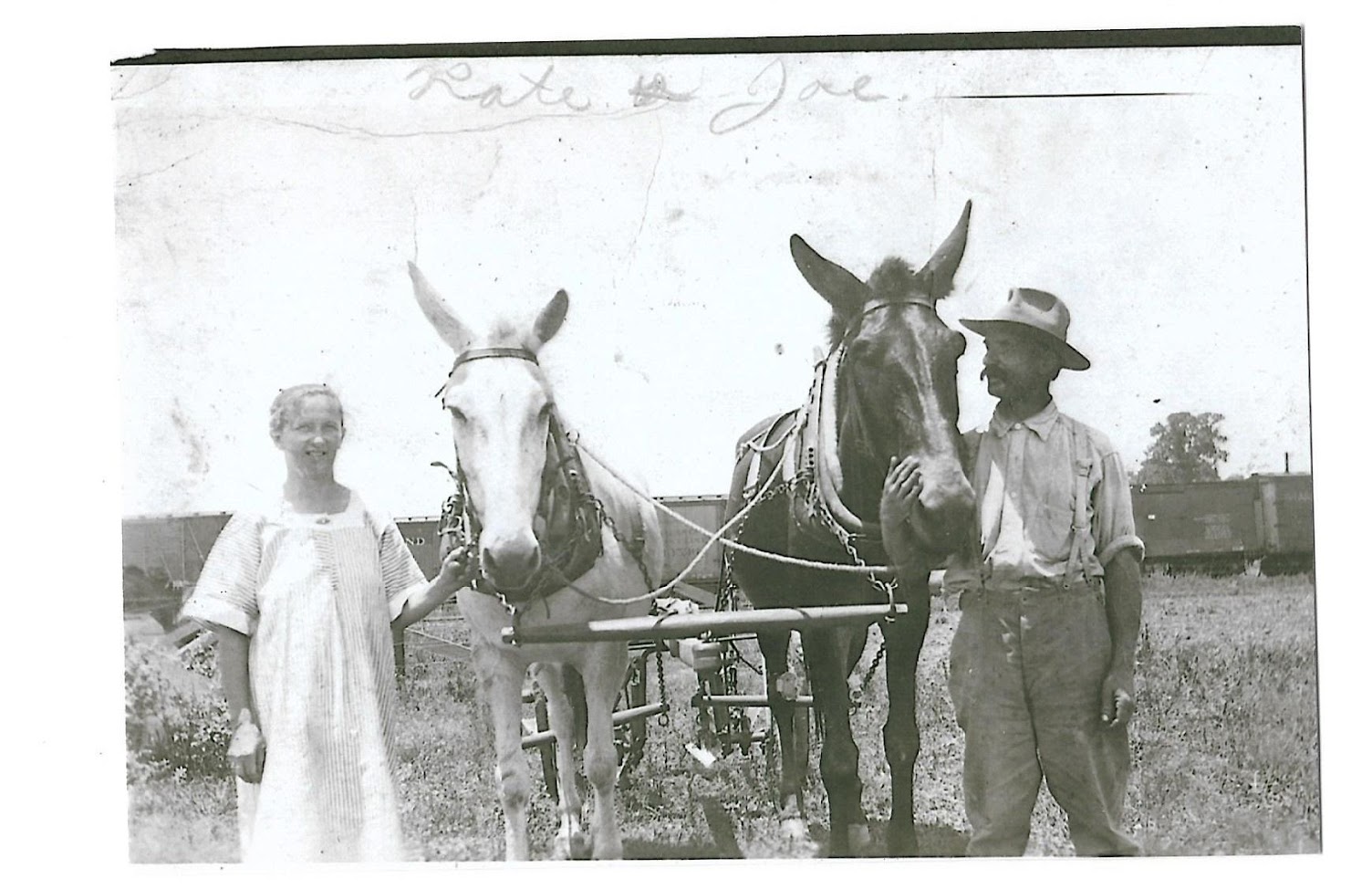
Mr. & Mrs. Pilz with Kate & Joe.

More People of Old Sugar Land

Click the image below to view a photo album of people of old Sugar Land.
   
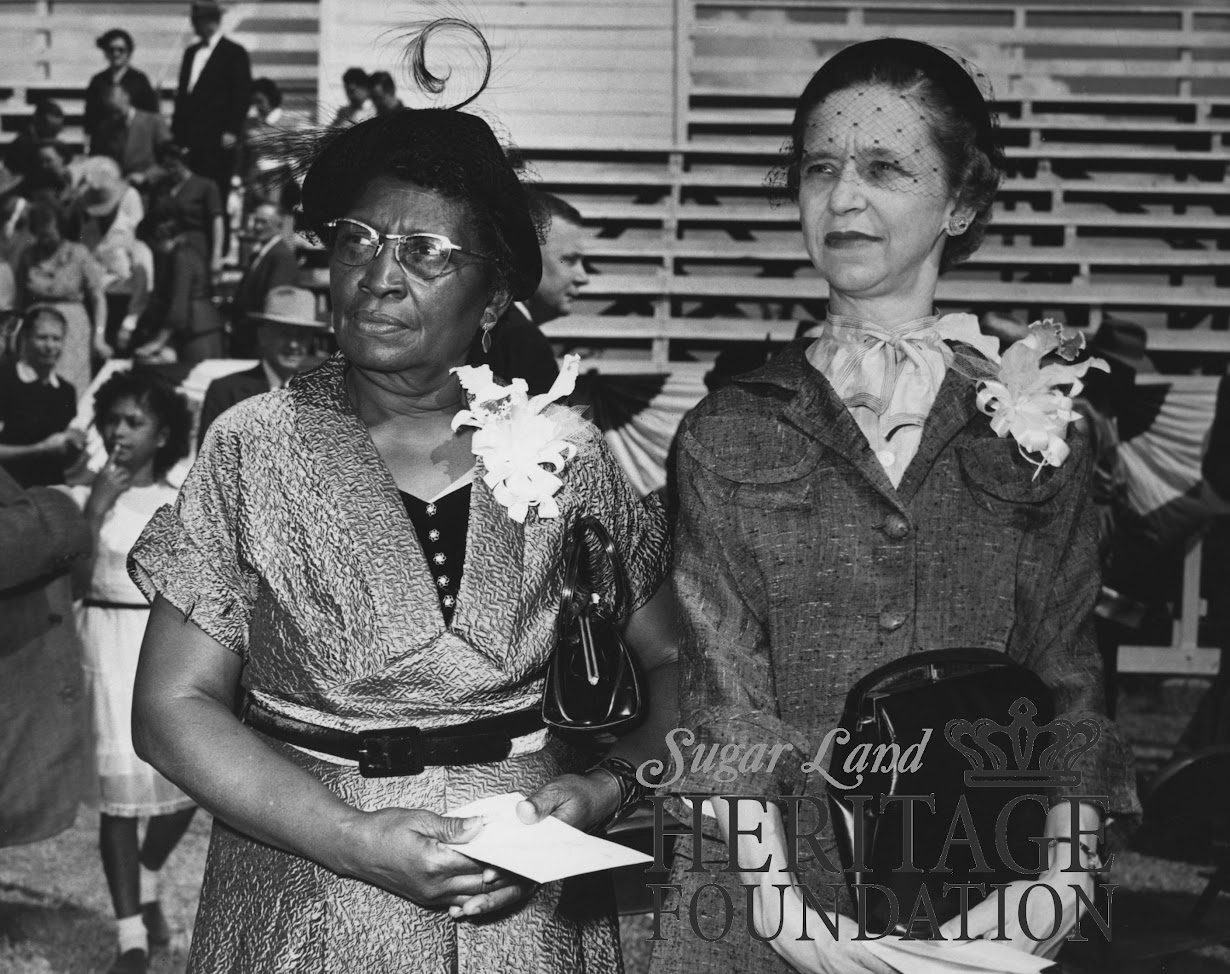
Cara Fisher & Regina Loper celebrate their 25th anniversary with Imperial Sugar Company in November 1953.

Sunday, May 7, 2017

The Old Sugar Land Dairy

Roy Lemke was in Sugar Land last week, and he dropped off some fascinating photos at the Sugar Land Heritage Foundation.  He's posted others on Facebook, which I've reposted on this blog.

Here's one that caught my eye. It shows Roy Lemke (senior) with the Sugar Land Dairy's delivery wagon. Fantastic. (We'll try to get a good scan in the future.)


I've posted other items about the dairy. In case you want to refresh your memory, here are links to the posts:

Friday, March 10, 2017

Sugar Land Tenant Farms

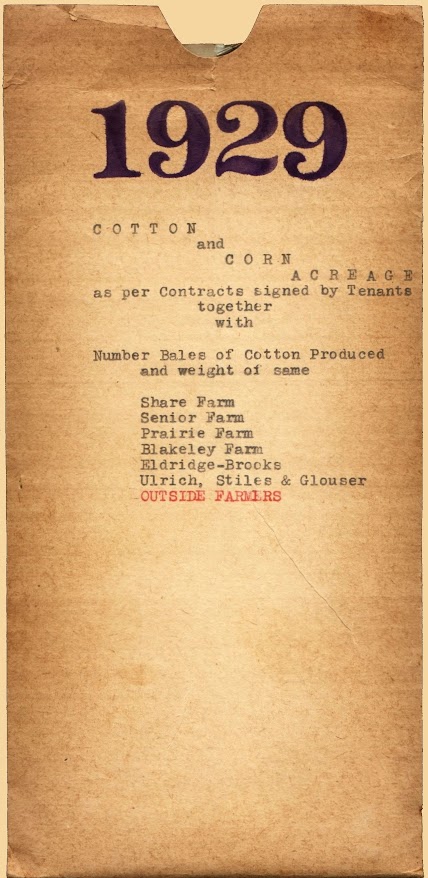
Several months ago I had a wonderful visit with Mr. Tom B. McDade (SLHS Class of 1940). We talked about a wide range of topics, but among other things he donated a collection of Sugarland Industries tenant farm records from 1929 to 1942 to the Sugar Land Heritage Foundation. His father was the clerk/bookkeeper for the Industries tenant farm operations and had saved these records long after he retired. Tom found them and wanted to give them to the SLHF.

These records are unique historical evidence of a forgotten part of old Sugar Land, but I haven't had enough time to give them proper attention.  I still haven't looked at them closely, but I wanted to post a brief selection now.  I chose the packet of records for 1929.

Here are some quick, summary points about what they contain:

1) The records cover cotton and corn crops, but cotton predominates by a large margin.

2) The Sugarland Industries Gin processed cotton from outside sources, as well as Industries farmers.  You'll see a separate list for these outside customers, showing the farmer and the farm owner, plus number of bales and total pounds.

3) You'll see lists for Share Farm (I assume these are Industries farms), Senior Farm, Prairie Farm, and Blakeley Farm. I'm not sure of the precise location of these farms (although I can make good guesses), or who actually owned them. I think the Industries probably owned the Prairie and Blakeley Farms, but I'll have to confirm that.

4) There are no dollar values, so I can't tell how much money was made on the crops. I'll try to find a cotton price for 1929 and make some rough calculations.

5) I assume some of these farmers worked part time at other jobs.  (Tenant farming may not have been their sole source of income.) Furthermore, I'm not sure about their contract with the Industries. I assume that in some cases the Industries supplied mules, seed, and other equipment and materials, which would mean some of these farmers were actually share croppers (using technical definitions of these occupations).

These records need a lot more analysis to uncover exactly what they tell us. Thank you, Mr. McDade for this interesting evidence from a little-know aspect of old Sugar Land.

Click the image below to view the records.
       

Sunday, September 18, 2016

Captain Brooks


Several people remembered the Brooks home on Dam Road along the east bank of Brooks Lake. I posted a 1980 photo last time. (Of course, Dam Road is gone, and it's now Lake Pointe Parkway.)

Bettye Anhaiser met Marjery Brooks Ashford, younger daughter of Captain Brooks, many years ago. She interviewed Marjery and collected some of her photos. Her recollections of old Sugar Land are fascinating. I've posted a few of her photos, which you can see by clicking the image below.

Here is a brief summary of Captain Brooks's life.  You can also click this link to read a a newspaper article on one of two attempts on his life. (Apparently, the Brooks family lived in Victoria before moving to Sugar Land.)

Captain Brooks
Captain Brooks (in white shirt) showing potato crop in Sugar Land. Date is uncertain. Location is probably the rail loading dock behind the old Mercantile Store.

Thursday, May 5, 2016

Flood Control & Water Management


We've had a lot of rain recently.  Houston and areas north of Sugar Land suffered serious flooding.  We're thankful Sugar Land did not.  I found some photos showing a major flood in 1935 in the Sugar Land Heritage Foundation's archive.

The disastrous 1899 and 1913 floods are better known, but the '35 flood must have been pretty bad because it happened after flood control measures (levees) had been built in the 1920s.

I'm not positive about the date of the first image, but I think it was taken in the 1920s when the levees were built.  It shows a crew and a drag line at an unknown location, but the cab has a sign saying "Sugarland Insustries, Sugar Land, Texas" painted on it.
  
  
The next photo was taken after the '35 flood and shows Highway 90A west of Sugar Land.  I don't know the exact location, but my best guess is near the old Sartartia Plantation.   Here's a Google Street View of the possible location today - the 1935 photo is immediately below it.


Highway 90A bridge near Sartartia during 1935 flood

Highway 90A bridge during 1935 flood
 
Flooded field along Highway 90A during 1935 flood
  
This last photo shows downtown Sugar Land flooded during the 1913 flood.  The area in the foreground is roughly where the Farmer's Market is held every Saturday.
  
Downtown Sugar Land in the 1913 flood

Wednesday, April 6, 2016

News & Updates


I want to catch up on news-&-update items that have collected in the recent past.  The first is an identification sent from Donna Christopher Baker (DHS '63) regarding the man in the photo below.

Moses Shelton near the time of his retirement in the '60s.
 
She spoke with her aunt, Faye Martin Baker, who tells us his name was Moses Shelton.  Faye said he also worked for her father, Robert F. Martin, who ran the lumberyard.  Many thanks to Donna and Faye for this identification.

I got some help from Jackie James (SLHS '57).  She has told me her father is the man on the far left in this photo from 1959, showing a tour of the new Melt House.  I wondered if that was her father (not W. H. Louviere, Sr.), but I couldn't be sure without confirmation.
 

 L to r: Tom James, Hugh Lynn, W. O. Caraway, & George Andre touring Imperial's new Melt House in 1959.
 
Jackie also told me the next photo was taken at the Slot home on Dogwood back in the '60s, and that's her daughter, Lynn Elise Slot, who died just a few months after this photo was taken.


Wayne Landin (DHS '66) helped with the photo I posted of the Presbyterian fundraising committee.   That is Rev. Donald Davidson in the center and his wife hidden behind the model of a church, which Ernie Wood is handing her.  Thanks, Wayne.  (His parents are on the right.  Bob Armstrong is on the far left.)


My thanks go to Randy Trncak (DHS '65) for help in identifying more children in Stephanie Youngblood Wilson's (DHS '65) photo of her kindergarten class at Mrs. Boyer's.  Randy told me that is Martha Greenwald on the swing at the far right with Roy Cordes, Jr. (DHS '65) and Danny Hrncir second from the left.  (I think I may have misidentified Danny as Bruce Edwards, Jr. when I originally posted this.)


Last, the Sugar Land Heritage Foundation is participating in Houston's 2016 FotoFest.  They are open on Thursday and Friday afternoons, as well as Saturdays.  (Call 281-494-0261 to confirm exact times.)  They have 8 new photos illustrating Sugar Land's era as a company town.


Tuesday, March 29, 2016

More Images of Old Sugar Land

 
The following article appeared in the November 1956 issue of The Imperial Crown and noted the demolition of two old buildings.  The first housed Sugar Land's meat and produce markets, but before it served those purposes, it was the town's saloon and gambling house.  I think Kempner & Eldridge repurposed it soon after they took over the Imperial Sugar Company and Sugar Land in 1908.

Here is a panoramic photo showing the building when it housed the town's meat and fresh produce markets.  It's the two-story structure in the center of the photo.  You can see the old tailor shop and shoe shop on its left.  That building became Sugar Land's first city hall in 1959.

Sugar Land's west side in the 1920s.

The article mentions that the old Marshall Canning Plant (earlier it was the Sealy Mattress Factory) was torn down at the same time.  Here are a couple of photos of that structure, which stood on the northwest corner of Main & Kempner Streets.

I found the following undated photo of Sugar Land's first drug store.  Sugar Land's first doctor's and dentist's offices were located in that building until the clinic at Ulrich & Kempner was built in the late 1930s.
 

Monday, January 25, 2016

Part 4: Ginning Cotton


This is the last in my series of posts about cotton, which is still a major crop in Fort Bend County, but not so much in its eastern half.  Until roughly 40 or 45 years ago, raising cotton was a significant part of Sugarland Industries, but once its land was sold off and the corporation dissolved, cotton was no longer part of our community.

Someone will have to help me with this, but the cotton gin (see images below) was shut down several years before the Industries dissolved.  I don't have a clue about the precise date.

The following article appeared in the August 15, 1925 issue of the Texas Commercial News, Sugar Land's local paper at the time.  The article goes into detail about the crop, the gin, and the condition of the '25 harvest.
 
 
Sugar Land's gin was located where the east end of Nalco's plant stands today (where Ulrich St. meets the railroad tracks).

The first two photos are blow ups from the third, which shows the gin in the 1920s. Note the mules and wagons.  I assume the large sacks are filled with seed.  (See the article above about processing cotton seed.)


The next photo was taken a few years later, I think.  (There are no dates on any of these photographs.)  As best I can tell, the hexagonal building on the right with the cupola doesn't appear in the earlier photo.
 

I've posted the next image before, but I've used it again to give an additional perspective of the gin.  (This image is also undated, but it's probably a scene before the '20s.)  The wagons in the foreground are parked in front of old The Red Barn Cafe's location a few decades later.  I've magnified the photo for close inspection, and I can't see any indication of a crossing where Ulrich St. should be.  If you looked closely at the previous post showing the 1928 map of Sugar Land, you saw Ulrich St. clearly marked, so this photo must be earlier than 1928.
  
This last photo is obviously modern, and it shows the gin in Crosbyton, east of Lubbock.  I've included it because it contrasts a modern gin with the one shown in the images below.  Those are cotton modules, which I've discussed in earlier posts, lined up beside the gin.  They may be hard to see, but in the distance on the right you can see two module haulers.  They look like boxcars.  One is tilted upward.  They are the modern version of the wagons you see in the image immediately above.
  
 
A friend found this short slide show which shows a gin in operation in Alabama.  Click this link to view the video.

Sunday, January 3, 2016

More People of Old Sugar Land

  
The photo was taken in 1961.  I'm fairly certain this man's last name is Shelton, but I'm having trouble determining his first name.  As you can see, he maintained the area at the plant entrance beside the Char House. (Maybe someone can provide his name.)


The next photo shows Hugh Charleton at the time of his retirement in 1965.  I'll have to research this, but I think he was a foreman for Sugarland Industries.  Note that he's standing in front of the old lumber yard on Imperial Blvd., roughly where the east end of the Nalco Plant is now located.
 

This next photo shows summer hires, Ollie Scott, Jr., Richard Sister, and Jack Nygren as they earn their pay in the Char House.  I think this photo was taken in 1963.
 

Saturday, November 7, 2015

Cotton Part 2: Hauling it to the Gin


Several weeks ago I posted an entry about harvesting cotton.  A college friend of mine grew up on a cotton farm just east of Lubbock, and he explained to me the differences in growing and harvesting cotton up in the South Plains versus here on the Gulf Coast.  He said harvested cotton up there is much dirtier than down here.  This picture from the 1950s shows why.  The lack of water means lots of bolls grow very low to the ground and become contaminated with soil.    Down here the plants grow taller with plenty of rain, so the bolls aren't nearly as close to the ground.
 
 
He also explained the 'evolution' of cotton hauling.  The photos I've shown in the past showed old-style wagons with sides made of wooden slats or chicken wire.  Here are two types of wagons; first, the old style with slats and then a more modern version with sturdy wire grating.  (The donkeys are my fiend's wife's pets.  I understand they live a life of luxury.)


Sometime in the late 1960s or early '70s gins and farmers began using 'rickers,' which produced ricks or compressed piles of cotton which were left in the fields.  These ricks were not tightly compressed or wrapped with a covering, so they were subject to damage by wind and rain. The gins sent mobile units that collected the ricked cotton and hauled it to the gin for processing.  I'm sure there are farms and gins who still use this technology.  Here are two photos of rickers.


Here are two photos I've posted in the past, showing cotton 'modules,' the newest technological advance.  The harvester compresses the cotton and puts a covering around it.  Notice they are rectangular cuboids, large rectangular blocks.  Gins have tilting flatbed trailers that can pick up these blocks and haul them to the gin. 
 

Monday, August 24, 2015

Picking Cotton


I've had a recent email conversation with a couple of my college buddies about cotton.  One of them is from Crosbyton, Texas where his family ran a cotton farm.  I've learned quite a bit about raising and processing cotton.  In fact, there's too much to put in one post, so I'll chop the topic into 4 posts.

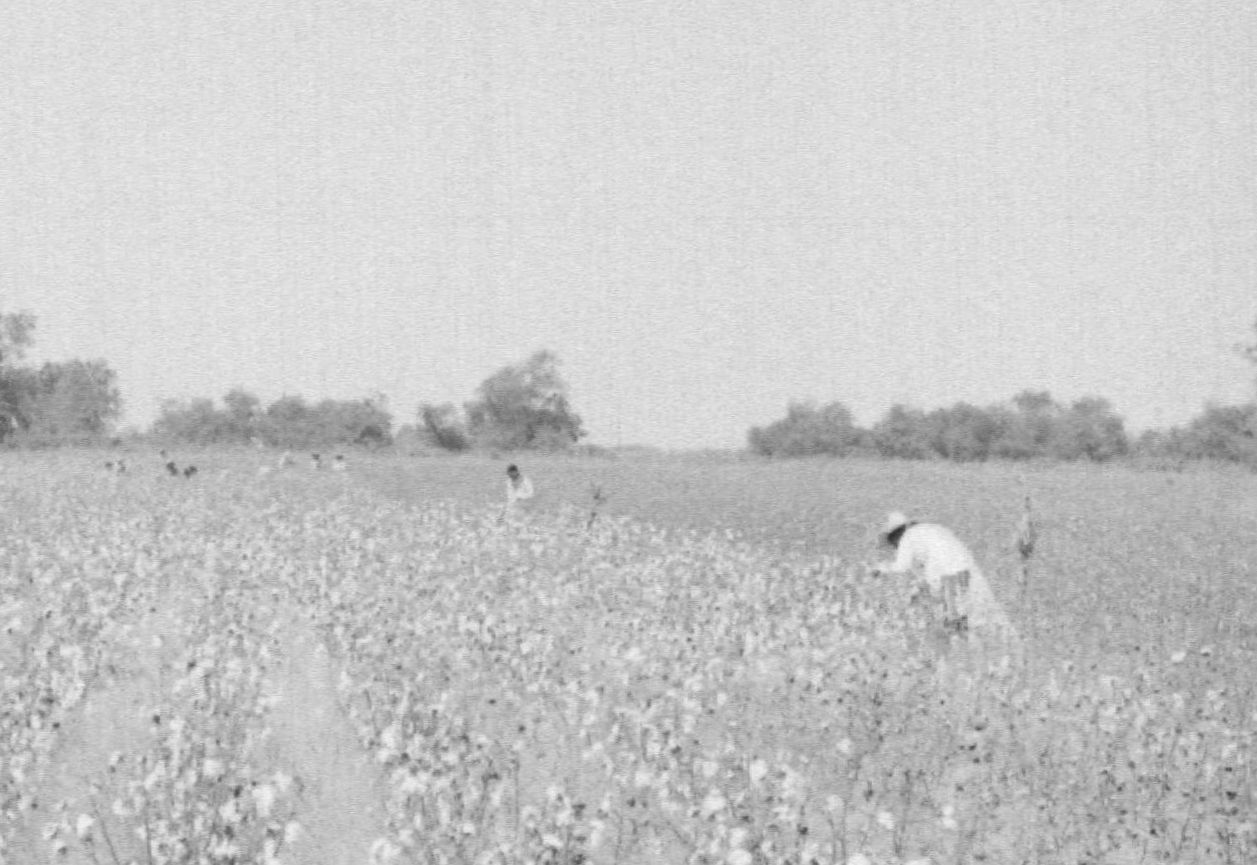
I'll start with picking because it often begins at this time of year.  Just a couple of photos showing field laborers at work will indicate the back-breaking nature of picking cotton by hand.

Undated photo of cotton field where Hall Lake is now located.

 Probably the same field during a harvest in the late 1950s.  (Note the laborers picking by hand.)
 
A magnification of the laborers.
 
Pickers dragged a large bag along the ground as they filled it with cotton.  Summer heat wasn't the only difficulty.  An adult (as you can see in the photo) had to bend over to reach the plants.  Eventually, tired backs forced pickers to work from a kneeling position.  They often wore knee pads to save wear and tear on overalls and sore knees.  

I guess children had an advantage in not having to bend over to reach the plants.  This photo shows students at a small school near Corsicana in 1913.  Each of them picked cotton before entering school that fall.  (Child labor was common in the cotton fields before mechanization.)
 
(Traces of Texas)

My friend up in the South Plains said picking cotton down here is different than it is up there.  Conditions up there meant hand-picking required pulling the burr from the plant.  (The burr is the dried shell from which the boll emerges.)  Down here the conditions (and maybe the hybrids we can grow) allowed pickers to pull the lint from the plant without taking the burr.  The lint still contained the seed, but it was far cleaner than cotton picked in north Texas.  This difference still applies to mechanical harvesting used today.

Of course, mechanized harvesting became common in the 1960s.  The next photo shows an early picker used in the same field south of old Sugar Land.  It looks like the machine is mounted on a tractor, although it's probably a permanent attachment.
 Rear view of an early mechanized cotton picker in field near Sugar Land.
  
  View of early mechanized cotton picker in field near Sugar Land.
 
Magnified view of early mechanized cotton picker in field near Sugar Land.
 
Technological advancements have continued to the present day. Click here to view a modern cotton picker.

Next time a short discussion of hauling cotton.

Wednesday, July 29, 2015

Cotton

I watched a 6-minute clip from The Texas Bucket list, recently, on the historic Burton Cotton Gin & Museum.  Click here to view the video.  This led to a discussion with some friends about cotton harvesting and ginning.

The Sugar Land Heritage Foundation archives has this undated photo of loaded cotton wagons lined up in 'downtown' Sugar Land waiting for a spot at the gin.  (The date of the photo is probably 1910, give or take a few years.)  


You can see the railroad tracks on the left side of the photo, so the camera is pointing west, down what is now Kempner St.  The wagons are parked about where the Farmer's Market is held today.  

Notice that the farmers have covered their wagons with tarps.  In my day, the wagons had sides made of chicken wire, and covers were optional.  During harvest time, there was probably enough cotton strewn along Brooks, Main, Kempner and Highway 90A to make a bale of cotton.

Here are some photos of the modern approach to harvesting cotton.  I took the first two a couple of years ago near the George Ranch Historical Park south of Richmond.


Obviously, a mobile unit came out to the field and formed those large blocks of clean, compressed cotton.  I didn't stop to get a closer look, so I thought maybe they were completely ginned, but a friend said that's not the case.  They are partially processed and still need further work at a gin.  He took the next photo of the same sort of blocks awaiting processing at a gin in Crosbyton, Texas just east of Lubbock.  Flat-bed trucks with tilting beds pick them up and haul them to the gin.
 
Photo by Bill Barksdale.
 
My friend said the gin was incredibly noisy, and that's the way I remember the old Sugar Land gin.  I went there once with my father when I was about 5-years old.  I was the kind of kid who didn't like loud noises, so I had my hands over my ears the whole time.

Wednesday, July 15, 2015

News & Updates


I regret that I have bad news to report.  Jesse Rayburn Morton, long-time Sugar Land resident passed away recently.  You may know his children: Gayle Morton Adler (DHS '65), Jesse M. Morton (DHS '67),  Janice Morton Padgett (DHS '70), and Lesa Morton Tyson.  (I'm not sure of Lesa's graduation year.)  Here is an obituary for Mr. Morton

Sandra Broughton Gandy (MCHS '59) also passed away recently.  Sandra was older sister to Bill Broughton (DHS '63) & Diane Broughton Lundell (DHS '65).  I'm not certain when sisters Jane Broughton Schiller and Joan Broughton Vaccaro graduated from MCHS.  Here is an obituary for Sandra.

My sincerest condolences go to the Morton and Broughton families for their loss of cherished family members.

Many old timers may have heard that Frances and Charlie Tise (SLHS '48) lost their home and most of their belongings in the devastating floods on Memorial Weekend in May.  They live in Wimberly and barely escaped the rampaging Blanco River.  Fortunately, their granddaughter lived near them and help them escape danger, and I think Charlie's brother Earl was able to give them shelter.


David Wickersham (DHS '63) has told me they are getting mail at their home address, so if you'd like to contact them please post a comment on this blog, and I'll send you their address.  (I'm reluctant to post it on an open blog.)  I'm sure they'd like to hear from friends. 

David also gave me some help identifying a fellow JC in the following photograph. Here's what he said:

Sorry to hear about Charles Thomas.  In the picture he and the others are wearing Jaycee hats so it must have been one of the many public events we worked at.  The one in the middle is Louis Mullberger (sp).  I do not know the other one; he looks like me but I do not remember being there.  We were all in the JCs around that time.
 
 
Jackie James (SLHS '57) has confirmed John Pauswang's (DHS '67) recollection that 'CU' was the brand used by Sugarland Industries.  She's trying to get me a photo of a sign on FM 359 showing the turn off to Foster Farms, which the Kempner family still owns.  The brand is included in the sign's artwork.

Here are a links to the Katy Heritage Society and their yearly bulletin, which serves as an annual report.  I never realized until recently that a large part of old Katy is in Fort Bend County.  I always assumed all of it was in Harris County.