Drop Down MenusCSS Drop Down MenuPure CSS Dropdown Menu
Showing posts with label Prison Farm. Show all posts

Thursday, May 31, 2018

Fort Bend Star Articles About Sugar Land History.

The Fort Bend Star ran two articles about Sugar Land history in its recent issue. The first recounts Sugar Land's successful transition from a company town to a municipality.

The second article is about re-installation of a 1937 plaque on the renovated Central Unit building, which now is home to the Houston Museum of Natural Science at Sugar Land.

Click the images below to view the articles.

Elected city officials at inauguration in 1959.

Plaque restored to former prison building. (Image courtesy of HMNS at SL.)

Thursday, July 30, 2015

More on the Pryor/Schumann House


I want to thank Jimmy Lingenfelter for posting on Facebook the following photos he took of the Schumann house in 2008.  (You'll recall I had an item about this house in my previous posts.)
 
2008

2008

2008
I posted this photo from the 1940s or '50s a couple of weeks ago.

1940s or '50s

I included this higher-altitude aerial photo from 1953 showing the house's relative location to Central Unit 1.

1953

I also posted this photo from the Texas Prison Museum showing what they believe is the same house in the late 19th century.  (It comes from the Pryor family, who resided in a house in that location during the Imperial Prison Farm era.)

Texas Prison Museum
  
Jimmy pointed out the general structure is all wrong, and I thought so too when I first saw this photo.  But then I noticed it was a possible fit if I flipped the photo horizontally, as shown here.  (I've seen a surprising number of old photos that were printed in the wrong orientation.)

Old photo flipped horizontally.

I'll admit it's not an exact match.  If they are the same house, there was certainly extensive remodeling.   No doubt I'll have to talk with my friends at the Texas Prison Museum to resolve this conundrum.

Wednesday, July 15, 2015

More Places of Old Sugar Land


These first set of photos shows old homes that were "out in the country" back in the old days.  

My thanks go to Mark Schumann (DHS '76) who posted the first photo on Facebook.  It shows the home where his grandparents, the Max Schumanns (Sr.), lived for a time.  I believe they moved from 4th Street out to this house and then sometime later moved back to The Hill.  I'm not certain of the dates, nor when this photo was taken, but judging by the car it must have been the 1940s or '50s.
 
 
The house was located just north of Central Unit 1.  This 1953 aerial will help orient you - the house is circled.  Notice the barn's white roof is very distinct and matches the location shown in the photo above.
 
  
We're trying to confirm the home was built originally for Superintendent Pryor, the first chief of the Imperial Prison Farm, which predated the Central Units by several decades.  Although we have no exact date, the Pryor home was built sometime in the 1880s or '90s.  The next photo shows it in 1899.  We think it's the same house shown in the picture above. 

1899 (Texas Prison Museum)
Another point of significance is that the Sugar Land Railroad had a stop called Pryor, which we assume was beside, or very close to the house.  The stop is marked on maps and train schedules, so there's no doubt about its existence. 

Next, I want to thank Stephanie Youngblood Wilson (DHS '65) for providing this photo of her grandparents' (the H. L. Dreiers) home on the northwest quadrant where the Southwest Freeway crosses Highway 90A.  The location is identified by the circle in the '53 aerial photo.

H. L. Dreier home about 1940.
1953

Notice the racetrack just east of the house.  Stephanie told me there was a time when the house wasn't air conditioned, and afternoon naps on summer weekends were interrupted by the sound of roaring engines coming through open windows.

The last photo is one of the Imperial refinery probably taken around 1908, when I. H. Kempner, Sr. and W. T. Eldridge, Sr. took over the Imperial Sugar Company.

About 1908.
Here's a shot of how the same location looks in recent years.  It's a Google Street View of the same location dated April 2011.

Wednesday, February 11, 2015

More People of old Sugar Land


An undated photo showing (l-to-r) Emily Neal, Tuta Hightower, Marsha Ferguson, Betty Ann Jenkins, Pam Barolo, and Gail Hull.  Jack Neal took this photo in the family backyard.  (Thanks, Emily.)

A photo showing Mark Schumann's 6th birthday party in 1964.  The location is the Schumann home on Lakeview.  (Thanks, Mark.)

Another photo of Mark Schumann's 6th birthday party as they cut the cake.  (Thanks, Mark.)

This isn't a photo of Sugar Land residents.  As the caption says it was taken in May 1913 and shows Texas legislators and staff on the front porch of the Imperial Sugar Company General Offices.  They were in Sugar Land to investigate prison system finances and reform.

Tuesday, January 6, 2015

More People of Old Sugar Land


I forgot to mention in my last set of posts that long-time Sugar Land resident and teacher, Jimi Neal, died late last year.  Unfortunately, I don't have an obituary, but I wanted to send my condolences to David (DHS '67), Henry (DHS '69), and Emily (DHS '73).  Mark Schumann has the only photo of her I could find.  It shows her as his first grade teacher in 1965.  (Thanks, Mark, for this and the additional photos.)
 
 
Here's another photo of Mark and his sister, Karen, standing on 6th St. in 1961.  You can see Kempner Stadium in the background.
 
 
This photo shows Robert Schumann (SLHS '41), family friend Babe Fischer, and Herbert Schumann (SLHS '37) at the home of Max Schumann on 4th St. in 1941.  (Max was Robert and Herbert's father.)  Robert is wearing an A&M Corps of Cadets uniform.  Herbert is wearing his US Army uniform.


I received this final picture from Sandy Rogers at the Texas Prison Museum.  (They have a surprising number of Sugar Land items.)  It shows a Mrs. Horton, wife of an employee at the prison farm, in front of Pike's Cafe in Sugar Land.  The date must be around 1939.  (I tried identifying the truck but had little luck.)  The photographer was C. C. Springfield, who worked for the Texas prison system.  (Thanks, Sandy.)


Wednesday, October 22, 2014

Updates


A few weeks back I posted an old newspaper article about a pre-trial hearing held at Sartartia in January 1896.  Click here to view the posting.  While doing further research, I learned that W. O. Ellis was the older son of Colonel Ellis, and he would die in a shooting with a tenant farmer the following August.  W. O. sounds hospitable in the January article, but accounts of the August shooting paint a much different picture of his character.  I'll post that story next time.

I posted the following photo (taken in 1935) quite a while ago and wondered who were the men appearing in it.  I recently found ids in a 1958 issue of The Imperial Crown, so now we know who they are.  Here's a reasonably good version of the image.


Rather than retype the text, I'll post The Crown photo with its caption.


Monday, October 6, 2014

Prison Farm News From the Late 1890s


I've come across three articles about the prison farm west of Sugar Land while researching old newspapers.  The first one comes from The Sunday Gazetteer published in Denison, Texas on Sunday, March 18, 1894.  

At this point in Texas history, the state employed a convict leasing system, in which convicts were leased to private businesses at a fixed daily rate to perform various types of labor. Some worked for railroads; others worked for manufacturers, but most worked as unskilled farm laborers.  The state operated conventional prisons in Huntsville and Rusk, but a large number of convicts were scattered across the state in private labor camps.

The heirs of Ambrose Littleberry Ellis and Edward H. Cunningham owned most of the land that now constitutes Sugar Land.  Both used convict labor in their operations.  This article gives you a snapshot of their involvement in convict leasing.  I recognize additional Fort Bend County landholders in the list: T. W. House and C. W. Riddick. Some of the others may have been Fort Bend County plantation owners, but I'm not sure.  You'll notice there were just under 4,000 prisoners in the state penal system.  Over half (2,158) were located in the prisons at Huntsville and Rusk.


The next article is rather long, a little odd, and only mildly interesting, except for the final 3 paragraphs which give a quick sketch of Sugar Land in 1896.  Like the other two articles I found, this one comes from The Portal To Texas History.  Click here to view the whole article which was published in the Fort Worth Gazette on Thursday, January 9, 1896.  It begins at the top of the third column, but since it's long, I'll summarize it for you.  

The State of Texas sued L. A. Whatley, Prison Superintendent, and Reddin Andrews, a prison sergeant, for $75.  The State claimed both men conspired to pay Andrews a month's wages for work time he didn't perform.  The article is unclear on how this came about, but the State claimed fraud and wanted it's money.

The newspaper explains that the trial was held in the depot at Sartartia (the old Walker Railroad Depot), which sat by the tracks roughly where the entrance to Central Unit 1 is now sited.  This makes sense because that's approximately where the alleged crime was committed.  The accused brought many friends and jammed them into that little building.  The State was represented by the County District Attorney, who wanted the trial delayed and moved to Richmond.  The defense team said no, but it sounds like they were overruled and the trial was moved.  (I haven't yet found a follow-up article, so I don't know how it all turned out.)

The proceedings were concluded pretty quickly, but it was close to lunch time, and there was no place for the famished crowd to find some nourishment.  I've clipped the final paragraphs that explain what they did.  W. O. Ellis was old Colonel Ellis's son, who would eventually die in a shoot out with a prison guard.  However, on that day he fed some peckish visitors.  Colonel Ed Cunningham was renowned for his hospitality, so the crowd that walked to Sugar Land was, no doubt, amply rewarded.  The Riddicks seem to have been equally generous hosts.  Sounds like none of the visitors left Sartartia that day with an empty stomach.


This final article comes from The Houston Daily Post, published on Monday, January 4, 1897.  Click here to view the complete version at The Portal To Texas History.  I've clipped just a couple of excerpts.  The first shows that Cunningham was by then the largest lessor of convict labor in the state.  The Ellis family doesn't appear in the list.  

If you look at the complete article, you'll see there are 'Contract' and 'Shared' Farms - Cunningham is listed under Contract Farms.  I'm not sure what the distinction is.


This excerpt gives a brief description of the Harlem Prison Farm and its financial performance.
Sunday, July 13, 2014

Odds & Ends


I came across these miscellaneous items as I researched old newspapers.  I thought they were interesting.

I've seen several articles about Sugarland Industries traveling to various parts of Texas to recruit labor.  (A little known fact is the Industries sent an emissary to Germany to recruit workers there.  More on that later.)  This article appeared in the Brownwood Bulletin, issued on August 13, 1919.

  
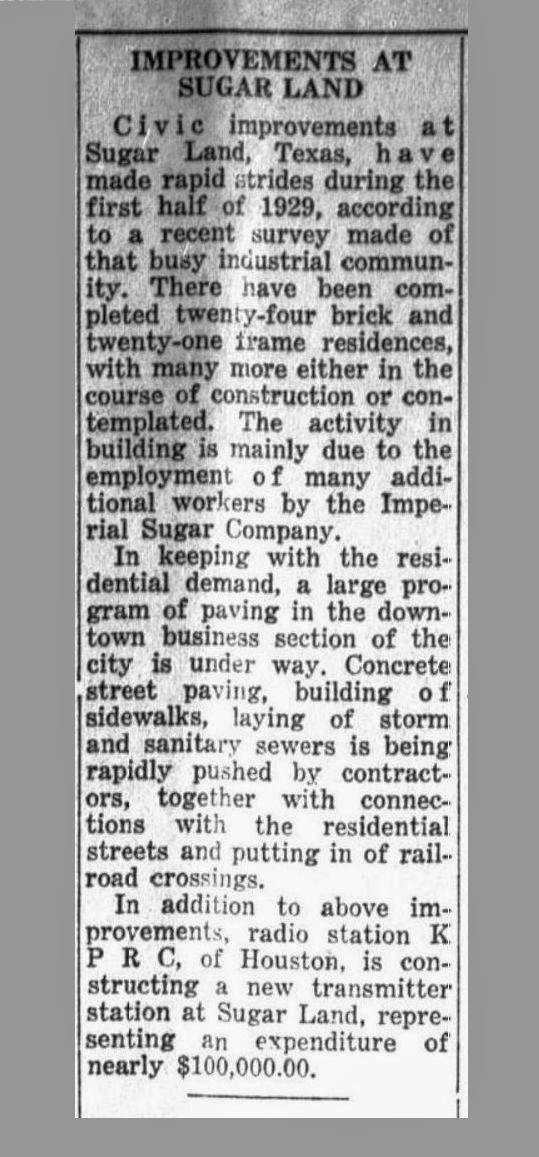
The next article appeared in The Naples (Texas) Monitor, issued on August 9, 1929.  The item I noticed appears at the bottom.  It says KPRC was constructing its transmitting station in Sugar Land.  (It was located near the intersection of Highway 90A and Eldridge Road - on the northeast corner.)

A few months later the Stock Market crashed and the Depression began.  KPRC relocated its transmitting station to La Porte about a year later.  I assume it was due to costs.


The Palestine Daily Herald printed the next article on September 1, 1908.   I know from the date that Kempner and Eldridge had just sold Sartartia (the Ellis Plantation) to the State of Texas, which would turn it into the Imperial Prison Farm, later Central Units 1 & 2.  This article mentions other units which were growing sugar cane and suggests the State was launching into the sugar business in a big way.
 
    
Last but not least, always beware of scam artists.
  

Cunningham's Grit (Final Installment)

  
For the past couple of weeks I've posted excerpts from a 1888 newspaper article about Colonel Edward H. Cunningham's application of advanced technology (diffusion processing) in his Sugar Land refinery.  The article appeared in the Fort Worth Daily Gazette.  Click here to view the entire article.  

An undated photo of Col. Edward H. Cunningham
  
As explained in the previous posts, the article describes Cunningham, Sugar Land, and the wide-spread attention his venture attracted in the sugar industry.  I wanted to close this series with the article's description of the milling and refining process as it was performed in Sugar Land in 1888.

The article described the old crushing process, which Cunningham was still using at the Imperial Mill.  Regular readers will remember it was located on the banks of Oyster Creek a little over a mile west of Sugar Land.  The site is across from Constellation Field.  It also describes the new diffusion process he installed in his bigger mill next to the refinery, which later became the Imperial refinery we all knew until it closed in 2003.

Cunningham mixed the liquid sugar from both mills and purified it in his refinery.  You'll notice the article doesn't mention a char house.  I assume the end product wasn't white table sugar as we know it, but more like Demerara sugar.  I think Cunningham added the first Char House in 1893, which would have allowed him to produce the white table sugar we consume today.  Here is the article.

The Process - Part 1.

The Process - Part 2.

The Process - Part 3.

The first paragraph mentions 'squads of men.'  They are the leased convict labor, who worked the cane fields around Sugar Land.  You see below several photographs of this operation taken roughly 10 to 15 years later, but it hadn't changed much in the intervening years.

A convict labor crew beside a mule train loaded with cut sugar cane.  These cars ran on flexible, movable track which could be relocated around the fields to facilitate loading.
   
A convict labor crew unloading a rail car filled with cut sugar cane.  The Imperial Mill is out of view.
The Imperial Mill is in the background.  The camera is facing east toward Sugar Land, which is behind the mill.  Constellation Field is now located on land out of view on the left.
A convict labor crew working a cane field in 1900.
 
A 1923 aerial showing what we think is old convict housing in Mayfield Park.  The U-shaped building on the east side of the quarters is probably a commissary and guards quarters.

The newspaper article mentioned bagesse, which are the remains of cane stalks after they've yielded their sucrose.  Most mills and refineries used bagesse as fuel, so industry experts were curious about the condition of this byproduct after undergoing diffusion processing.  

Cunningham chose to use bagesse as a raw input for a paper mill.  He was the first person in the US to attempt this type of paper production.  The product was rough, wrapping paper, similar to kraft paper.  Actually, Cunningham's mill was the first to produce paper of any kind in Texas.   Here is photo of bagesse piling up on the east bank of Oyster Creek across from the refinery.  The paper mill was just across Main Street, roughly where the camera is located. (I assume it is on the roof of the building.)

   
Finally, here's a photo of Cunningham's home, which stood on the northeast corner of the intersection of Brooks and Guenther Streets.
  

Sunday, July 6, 2014

Flanagan Road & West Sugar Land, 1952 & Today


I made a simple little video of west Sugar Land using a Fort Bend County aerial taken on March 6, 1952 and a current Google Satellite image.  I didn't spend a lot of time overlaying the images precisely, but they are close enough that you can make the transition.

I recently went with John Frierson and his sister Cindy to the old location of Flanagan Road and the site of their family home, which was the original Buck Flanagan family home.  It's gone now - so is the road.  There's just a trace of the road bed in the field.  We haven't found the exact site of their home, but we know the general location.  It's within the trees that appear on the Google image.

Sunday, June 29, 2014

A Failed Attempt At Prison Farm Centralization in 1929


While researching old newspapers, I found this short, front-page article in the Breckenridge  (Tex.) Gazette published on November 6, 1929.  It mentions an effort (which eventually failed) to centralize, and modernize the Texas prison system.  As the article explains, there were three competing proposals, one of which nominated Sugar Land as the location for the new centralized prison.


An article at the Texas State Library and Archives explains what happened.  The Legislature passed a funding bill, which Governor Dan Moody refused to sign.  It provided enough funds to upgrade existing facilities, but not a penny to build a modern, centralized prison.  Click here to read the article.   (Click here to read more on that era of the Texas prison system's history.)

Central Units 1 & 2 were constructed as a result of the Legislature's 1930 appropriation for upgrades.  I'll have to research the exact dates, but I'm pretty certain they were built in 1930 & 1933.

Sunday, June 22, 2014

Follow Up


I found another photo of Dorothy Trout Mason (SLHS '31) later in her life.  (She was the Sugar Land woman who joined the US Navy during WWII, and worked in Washington, D. C., maybe as a secretary to James Forrestal, Secretary of the Navy.)
 
  
I wish I could remember the name of the woman on the left, but that is Dorothy in the middle with Mrs. Martha Pirtle on the right.  I don't have a date, but it was probably taken in the 1970s.

We've had some discussion about a woman who appears in the 1947 Awards Banquet photo.  Several of us think it is Etna Schindler.  Any other suggestions?
   
 
Belinda Jenkins Faison (DHS '69) identified her father in the same photo.  I don't know how I missed him.

Roy Lemke (DHS '74) has identified Joe Ruzicka, Maintenance Supervisor of the Packing Department, as one of the men in the most recent photo of Imperial employees.

Joe Ruzicka

And finally, Jon Pitts (DHS '61) helped me out with the Jester brick manufacturing plant.  (Thanks for the great info, Jon.)  Here's what he said:
  
Chuck, the Jester Brick Plant shut down in the summer of 1979. I know this because I was the one who shut it down. I worked there from January 1975 till I shut it down and was the last state employee to be classified, "Brick Plant Manager". It operated at the Jester 1 site from 1934 till 1979. I don't know the exact location prior to 1934, but I'm sure it was not very far away from the final location, because of the clay deposit location pattern. I possess the last brick that was manufactured at the plant.

The Imperial Mill Burns in 1914


While doing some research in old newspapers I found a few contemporaneous articles about the Imperial Mill, which burned 100 years ago last January.  I've posted article in the past about the sugar mill that sat on the bank of Oyster Creek about a mile west of the Imperial refinery.  It was on the south bank just across from the right field wall in Constellation Field.   The sugar mill appears in the distance and has a tall smoke stack on it.
  
 
It was built in 1883 on what was then Ellis Plantation property.  Eventually, Kempner & Eldridge sold the Ellis Plantation (including this acreage) to the State of Texas, which turned it into the prison farm.  However, Kempner & Eldridge retained ownership of the sugar mill.  At the time of the fire, Kempner & Eldridge were in a dispute with the State about the latter's fulfillment of the sales contract.  That's why there was some controversy about the fire.

The railroad tracks in the photo are not the tracks paralleling Highway 90A.  These tracks were taken up sometime in the 1930s.  The camera is facing eastward and positioned on land that is now the Municipal Airport.  

I've zoomed the left-hand and right-hand margins of the photo, so you can see some details.  The right-hand margin shows what might be the old Ellis Plantation home that served as W. T. Eldridge, Sr.'s home until 1928.  It sat next to the red-brick Char House and was demolished in 1963.  Click here to see a photoClick here to read an article about its demolition.

Left margin of Imperial Mill photo.

Right margin of Imperial Mill photo.

The following newspaper article comes from The Portal to Texas History Web site at the University of North Texas.  I've clipped the image to make it easier to find and read, but I've also included a link in case you want to see the complete page.  Click here to view the whole page.  Notice that they got the headline wrong.  The refinery didn't burn; it was the sugar mill.

The Bryan Daily Eagle and Pilot, January 30, 1914.